
Book guide and evaluation
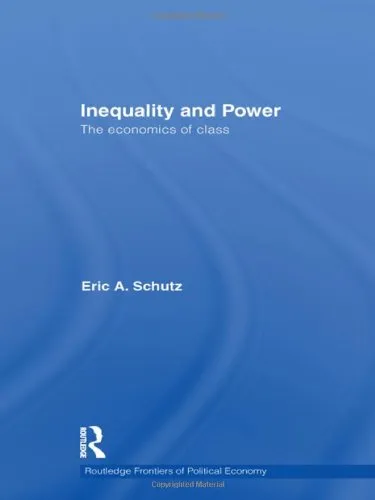
Inequality and Power: The Economics of Class
Eric A. Schutz
English
Unordered
Economics
4.5 / 5
0 reviews
2011
Published
241
pages
403
views
This book is about the causes and consequences of economic inequality in the advanced market economies of today. It is commonplace that in market systems people choose their own individual economic destinies, but of course the choices people make are importantly determined by the
Before you read
What will you get from this book?
This book is about the causes and consequences of economic inequality in the advanced market economies of today. It is commonplace that in market systems people choose their own individual economic destinies, but of course the choices people make are importantly determined by the alternatives available to them: economic disparity arises mainly from unequal opportunity. Yet this merely begs the question; from whence do the vast existing inequalities of opportunity arise? This book theorizes power and social class as the real crux of economic inequality. Most of mainstream economics studiously eschews questions involving social power, preferring to focus instead on "individual choice subject to constraint" in contexts of "well-functioning markets". Yet both "extra-market" power structures and power structures arising from within the market system itself are unavoidably characteristic of real-world market-based economies. The normal working of labor and financial markets engenders an inherent wealth-favoring bias in the distribution of opportunities for occupational choice. But that bias is greatly compounded by the economic, social, political and cultural power structures that constitute the class system. For those power structures work to distribute economic benefit to class elites, and are in turn undergirded by the disparities of wealth they thus help engender. Inequality and Power offers an economic analysis of the power structures constituting that class system: employers’ power over employees; the power of certain businesses over others; professionals’ power over their clients and other employees; cultural power in the media and education systems; and political power in "democratic" government. Schutz argues that a "class analysis" of the trend of increasing economic inequality today is superior to the mainstream economic analysis of that trend. After considering what is wrong with power-based inequality in term of criteria of distributive justice and economic functionality, the book concludes with an outline of various possible correctives. This book should be of interest to students and researchers in economics, sociology, political science and philosophy, as well as anyone interested in the theories of social class.
Ask this book
Your question is answered in the context of this title and author. Each answer uses 2 points.
Sign in to ask the book assistant.
Reader reviews
0 reviews, 4.5 average out of 5
No reviews yet
If you have read this book, help the next reader with your experience.
Write a review
Sign in to publish a review.
Reader questions and answers
Ask a focused question and learn from the community.
Sign in to ask or answer a question.
No questions yet
Be the first to ask a clear, useful question.
What to read next
Related references that continue this learning path.

International Sales Law: A Guide to the CISG
Ingeborg Schwenzer;Christiana Fountoulakis;Mariel Dimsey
2019
View book

The Law of Damages in International Sales: The CISG and Other International Instruments
Djakhongir Saidov
2021
View book