Book guide and evaluation
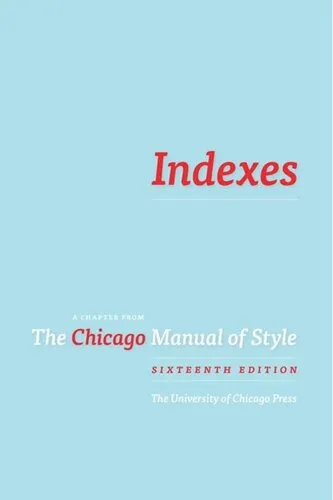
Indexes: A Chapter from The Chicago Manual of Style, 16th ed.
University of Chicago Press Staff
English
Beginner
vocab
4.5 / 5
0 reviews
2010
Published
67
pages
439
views
Discover the essential guidelines to creating precise and effective indexes with Indexes: A Chapter from The Chicago Manual of Style, 16th ed. This indispensable resource serves as a critical tool for writers, editors, and publishers who aim to enhance the accessibility and nav
Before you read
What will you get from this book?
Discover the essential guidelines to creating precise and effective indexes with Indexes: A Chapter from The Chicago Manual of Style, 16th ed. This indispensable resource serves as a critical tool for writers, editors, and publishers who aim to enhance the accessibility and navigability of their written works through well-crafted indexes.
Detailed Summary of the Book
The art of index writing may often seem daunting, yet its significance in academic, technical, and professional writing cannot be underestimated. Indexes: A Chapter from The Chicago Manual of Style, 16th ed. unravels the complexities involved in this nuanced task, providing readers with comprehensive insights into the principles and practices of index creation. The book walks the reader through various components of an index, covering topics such as indexable topics, formatting standards, alphabetization, cross-referencing, and the variations suitable for electronic and print media. Not only does the manual address technical specifics, but it also discusses cognitive aspects, bridging the science of information categorization with the art of user accessibility. This chapter ensures that content becomes easily retrievable, allowing end-users an intuitive experience when seeking specific information within a text.
Key Takeaways
- Understanding Components: Gain an in-depth understanding of what makes up a well-structured index and how each element fulfills its role for the reader.
- Best Practices: Learn about the industry standards and best practices for formatting, including considerations for typography, layout, and consistency.
- Technical Precision: Delve into the technical aspects such as alphabetization rules, handling of numerals, and subject categorization to ensure accuracy and completeness.
- User-Centric Approach: Focus on the user experience by learning how to create indexes that are intuitive and responsive to a reader's needs.
- Electronic vs Print: Distinguish between the needs and methodologies appropriate for electronic publications versus traditional print versions.
Famous Quotes from the Book
“A good index is not an alphabetical list, but a systematically organized guide to the information and arguments contained in a book.”
“Professional indexers are translators of knowledge, who interpret the complexities of a text and make them accessible to future readers.”
Why This Book Matters
While digital search technologies continue to evolve, the significance of human-curated indexes remains pivotal. Indexes: A Chapter from The Chicago Manual of Style, 16th ed. serves as an authoritative guide that underscores the importance of well-constructed indexes in making vast volumes of information comprehensible and accessible. This specialized guidance is invaluable for authors, academics, publishers, and editors who are involved in the production of complex texts where referencing precision and ease of access are paramount. By adopting the guidelines provided in this manual, users can unlock the full potential of their manuscripts, thereby enhancing scholarly communication and education. This book remains a cornerstone in the field of editorial practices, maintaining its longstanding reputation as a definitive resource in the art of index creation.
Ask this book
Your question is answered in the context of this title and author. Each answer uses 2 points.
Sign in to ask the book assistant.
Reader reviews
0 reviews, 4.5 average out of 5
No reviews yet
If you have read this book, help the next reader with your experience.
Write a review
Sign in to publish a review.
Reader questions and answers
Ask a focused question and learn from the community.
Sign in to ask or answer a question.
No questions yet
Be the first to ask a clear, useful question.
What to read next
Related references that continue this learning path.

An introductory New Testament Greek method. Together with a manual, containing text and vocabulary of Gospel of John and lists of words, and the elements of New Testament Greek grammar.
Revere Franklin Weidner;William Rainey Harper
1889
View book