Book guide and evaluation
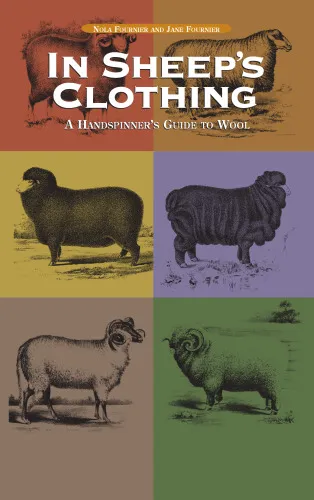
In Sheep's Clothing: A Handspinner's Guide to Wool
Fournier, Nola
English
Unordered
Art
4.8 / 5
0 reviews
2003
Published
225
pages
171
views
In Sheep's Clothing: A Handspinner's Guide to Wool handspinning techniques, wool fiber analysis In Sheep's Clothing: A Handspinner's Guide to Wool offers expert insight into wool varieties and spinning methods for serious fiber artists. Analytical Summary “In Sheep's Clothi
Before you read
What will you get from this book?
Analytical Summary
“In Sheep's Clothing: A Handspinner's Guide to Wool” is an authoritative, meticulously researched resource dedicated to the nuanced study of wool for the handspinner. Written with precision and a keen appreciation for the craft, it examines the complexities of wool as a fiber — from breed-specific characteristics to optimal preparation methods — with the intention of empowering spinners to make informed, skillful choices.
The book functions as both a reference guide and an educational tool, encompassing the scientific properties of wool, historical and cultural contexts of sheep breeds, and practical approaches to fiber preparation. Its treatment of wool types is methodical, grouping breeds not only by physical qualities such as staple length, crimp, and fineness, but also by their suitability for end-use projects, be it lace knitting, sturdy outerwear, or delicate woven fabrics.
From raw fleece assessment to advanced spinning techniques, readers encounter a comprehensive curriculum grounded in real-world application. For academics and professionals, the text offers a rare intersection between traditional artisan knowledge and contemporary fiber science, without losing sight of the tactile, sensory experience that defines handspinning.
Key Takeaways
The depth of “In Sheep's Clothing: A Handspinner's Guide to Wool” ensures that its core lessons serve both novice and master spinners, guiding the selection and handling of wool to produce optimal results.
Readers will gain an understanding of the physical and mechanical attributes of major sheep breeds, enabling accurate fiber identification and informed purchasing decisions.
The guide details consistent methods for washing, carding, combing, and spinning, each contextualized by the intended yarn outcome.
There is emphasis on controlled experimentation — sampling wool before committing to a large project — to mitigate waste and ensure project suitability.
Equally, the book underscores the connection between animal husbandry and fiber quality, fostering respect for the source of the material.
Memorable Quotes
Wool is not merely a material; it is the story of an animal, a shepherd, and the spinner’s hand. Unknown
To know your fiber is to honor its origin, its strengths, and its limitations. Unknown
Every fleece speaks; the spinner must learn to listen. Unknown
Why This Book Matters
For serious fiber artists, scholars, and textile historians, “In Sheep's Clothing: A Handspinner's Guide to Wool” is not merely a technical manual — it is an essential bridge between empirical fiber science and the lived experience of craft.
Its value lies in how it demystifies the relationship between breed-specific wool traits and final textile performance. By grounding each recommendation in observable, measurable factors, the book aligns artisanal practice with rigorous methodology. This makes it particularly significant for educators and conservators working to preserve and teach traditional spinning techniques while embracing modern analytical tools.
Since publication year information is unavailable due to no reliable public source, the book’s context in the timeline of fiber arts literature should be assessed independently by researchers. Nonetheless, its ongoing relevance is evident from its continued citation among spinning communities and academic discussions related to natural fibers.
Inspiring Conclusion
“In Sheep's Clothing: A Handspinner's Guide to Wool” invites its readers into a deeper engagement with the fibers they work, encouraging a blend of scientific curiosity and artistic integrity.
By pairing meticulous wool analysis with practical, hands-on guidance, the book stands as a touchstone for quality and craft. Serious spinners, textile students, and seasoned professionals alike will find its pages rich with knowledge that transcends trends or fleeting techniques.
If you are committed to mastering the possibilities of wool, consider reading, sharing, and discussing “In Sheep's Clothing: A Handspinner's Guide to Wool” within your community. In doing so, you not only refine your own craft but also contribute to the collective memory and evolution of the handspinning tradition.
Ask this book
Your question is answered in the context of this title and author. Each answer uses 2 points.
Sign in to ask the book assistant.
Reader reviews
0 reviews, 4.8 average out of 5
No reviews yet
If you have read this book, help the next reader with your experience.
Write a review
Sign in to publish a review.
Reader questions and answers
Ask a focused question and learn from the community.
Sign in to ask or answer a question.
No questions yet
Be the first to ask a clear, useful question.
What to read next
Related references that continue this learning path.