

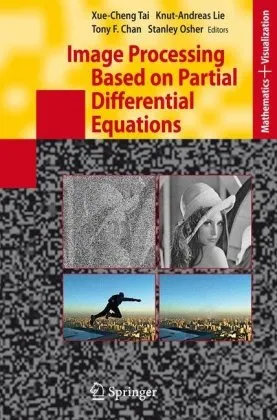
Book guide and evaluation
Image processing based on partial differential equations: proceedings of the International Conference on PDE-Based Image Processing and Related Inverse Problems, CMA, Oslo, August 8-12, 2005
Xue-Cheng Tai,Knut-Andreas Lie,Tony F. Chan,Stanley Osher
English
Beginner
Software Engineering
4.7 / 5
0 reviews
2007
Published
436
pages
385
views
Detailed Summary of the Book The book "Image Processing Based on Partial Differential Equations: Proceedings of the International Conference on PDE-Based Image Processing and Related Inverse Problems, CMA, Oslo, August 8-12, 2005" is a compilation of cutting-edge
Before you read
What will you get from this book?
Detailed Summary of the Book
The book "Image Processing Based on Partial Differential Equations: Proceedings of the International Conference on PDE-Based Image Processing and Related Inverse Problems, CMA, Oslo, August 8-12, 2005" is a compilation of cutting-edge research papers presented at an esteemed conference held in Oslo, Norway. This conference marked a pivotal moment in the intersection of partial differential equations (PDEs) and image processing, attracting leading experts from around the globe to discuss advancements, challenges, and applications of PDEs in image analysis.
Within the domain of computational image processing, PDEs provide a rigorous mathematical framework for addressing various issues such as noise reduction, image inpainting, segmentation, and edge detection. This collection encapsulates numerous contributions that explore innovative methodologies using PDEs to solve such image processing problems. While each chapter delves into specific topics, collectively, they underline the flexibility and effectiveness of PDEs as tools for image enhancement and interpretation.
The research presented not only focuses on theoretical advancements but also showcases practical applications extending into medical imaging, computer vision, and multimedia technologies. As such, the book provides a substantial resource for researchers, practitioners, and students who are eager to understand how PDEs are used to model and address real-world problems in image processing.
Key Takeaways
- Partial Differential Equations are powerful tools in modeling and solving complex image processing tasks.
- The proceedings include diverse methodologies that leverage PDEs for enhanced image analysis capabilities.
- Practical applications of these advanced techniques are thoroughly discussed, with examples from fields like medical imaging and computer vision.
- Readers will gain insights into both the theoretical underpinnings and the implementation challenges of PDE-based image processing approaches.
Famous Quotes from the Book
"The elegance of partial differential equations lies in their simplicity and their capability to capture complex processes efficiently."
"In the realm of image processing, where clarity and detail are paramount, PDEs serve as both sculptor and guardian of visual information."
Why This Book Matters
This book is significant because it brings together the pioneering thoughts and methodologies at a juncture when image processing was significantly evolving. The utilization of PDEs as a framework in digital imaging and related inverse problems offers a pathway to more precise, effective, and innovative solutions. This work doesn't just chronicle the state of the art in 2005 but also sparks future research directions, setting a benchmark for ongoing advancements in mathematical imaging.
The interdisciplinary nature of the conference, as reflected in the book, echoes the need for collaboration across mathematics, computer science, and engineering. By presenting a comprehensive and multifaceted view of PDE-based approaches, the book strengthens the theoretical foundation necessary for tackling future challenges in image processing, inspiring both new generation researchers and seasoned experts in the field.
Ask this book
Your question is answered in the context of this title and author. Each answer uses 2 points.
Sign in to ask the book assistant.
Reader reviews
0 reviews, 4.7 average out of 5
No reviews yet
If you have read this book, help the next reader with your experience.
Write a review
Sign in to publish a review.
Reader questions and answers
Ask a focused question and learn from the community.
Sign in to ask or answer a question.
No questions yet
Be the first to ask a clear, useful question.
What to read next
Related references that continue this learning path.


Finite Fields with Applications to Coding Theory, Cryptography and Related Areas: Proceedings of the Sixth International Conference on Finite Fields and Applications, held at Oaxaca, México, May 21–25, 2001
Simeon Ball,Michel Lavrauw (auth.),Gary L. Mullen,Henning Stichtenoth,Horacio Tapia-Recillas (eds.)
2002
View book