

Gray's Anatomy for Students (3rd edition)
Richard Drake,A. Wayne Vogl,Adam W. M. Mitchell
2014
View book
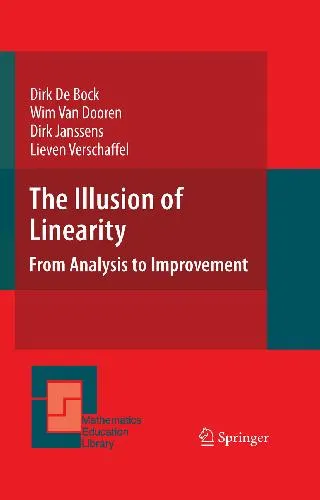
Book guide and evaluation
De Bock D.,Verschaffel L.
0 reviews
Published
pages
views
Introduction Welcome to "Illusion of Linearity: From Analysis to Improvement," a comprehensive exploration of one of the most pervasive misconceptions in mathematical education and cognition. This book is designed not only to diagnose the persistent over-reliance on linear
Before you read
Welcome to "Illusion of Linearity: From Analysis to Improvement," a comprehensive exploration of one of the most pervasive misconceptions in mathematical education and cognition. This book is designed not only to diagnose the persistent over-reliance on linear models in various domains but also to present strategies for educators and learners to overcome this cognitive bias.
In "Illusion of Linearity: From Analysis to Improvement," we delve into the concept of the linearity illusion, which manifests itself when individuals, both students and adults, consistently over-apply linear reasoning and models even when inappropriate. This book starts with a detailed analytical approach to understanding why linearity holds such a strong psychological sway over learners’ minds. We examine the roots of this phenomenon through empirical studies, educational psychology analyses, and cognitive development perspectives.
Our treatment of this subject is multi-faceted: we begin with foundational concepts and definitions, distinguishing between legitimate instances of linear relationships and the seductive error of perceiving linearity where it doesn't exist. The book progresses to:
By reading this book, you will primarily gain an understanding of the following key areas:
"The simplicity of linearity charms the mind, but genuine understanding demands the courage to venture beyond its confines."
"In education, we must nurture discernment over default assumptions, preparing learners to embrace complexity with curiosity."
Despite advances in educational methodologies and cognitive sciences, the illusion of linearity remains a significant barrier to deeper scientific understanding, innovation, and critical thinking. This book is vital because it addresses a gap in the educational landscape—ushering in a paradigm shift that emphasizes non-linear thinking and adaptive problem-solving. It is crucial not only for educators who aim to refine their teaching practices but also for learners who desire to navigate the complexities of both academic subjects and real-world challenges effectively.
By equipping readers with tools and strategies to recognize and dismantle this illusion, "Illusion of Linearity: From Analysis to Improvement" serves as both an educational guide and a call to action for fostering a more robust and adaptive mindset across diverse areas of life and study.
Your question is answered in the context of this title and author. Each answer uses 2 points.
0 reviews, 4.4 average out of 5
Sign in to publish a review.
Ask a focused question and learn from the community.
Related references that continue this learning path.
Richard Drake,A. Wayne Vogl,Adam W. M. Mitchell

Richard L. Drake;A. Wayne Vogl;Adam W.M. Mitchell

Doris S. Warriner (editor)
Adler, Irving;Hess, Lowell