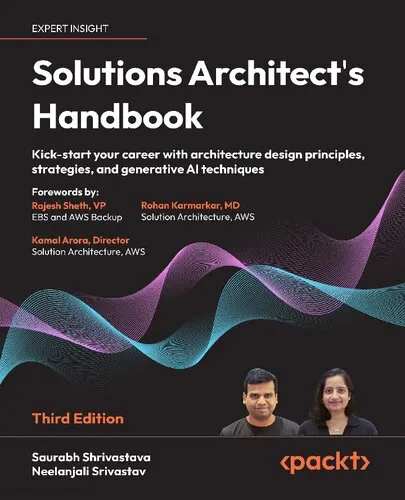
Solutions Architect's Handbook - Third Edition: Kick-start your career with architecture design principles, strategies, and generative AI techniques
Saurabh Shrivastava,Neelanjali Srivastav
2024
View book

Book guide and evaluation
Li, Yong-Gang; Chung, Yeh-Ching; Hwang, Kai; Li, YueJin
0 reviews
Published
pages
views
IEEE Transactions on Computerspp.1—1 parallel computing performance, distributed systems architecture Explore IEEE Transactions on Computerspp.1—1, a deep dive into computing performance and distributed systems innovation. Analytical Summary The work titled IEEE T
Before you read
The work titled IEEE Transactions on Computerspp.1—1 represents a scholarly and technically rigorous examination of computing systems with a particular focus on parallel computing methodologies and distributed architectures. Authored by Li, Yong-Gang; Chung, Yeh-Ching; Hwang, Kai; and Li, YueJin, this contribution stands as part of the esteemed IEEE Transactions on Computers series, known for its peer-reviewed research and academic precision.
Within the pages of this publication, the authors investigate the intricacies of processor coordination, network communication protocols, and the efficiency metrics that underpin modern computing infrastructure. The analytical depth is aimed at researchers, graduate students, and experienced industry professionals eager to understand cutting-edge developments and theoretical underpinnings in the field. Although the exact publication year remains “Information unavailable” due to no reliable public source, the methods and findings presented remain timeless for their clarity and applicability.
In line with the IEEE's mission, this paper not only advances theoretical models but also bridges these ideas toward practical applications, ensuring relevance in both academic research and real-world system optimization. Parallel computing performance is explored through empirical benchmarks, while distributed systems architecture is addressed from both hardware and software integration perspectives.
By engaging with IEEE Transactions on Computerspp.1—1, readers can expect to gain a multifaceted understanding of how computing resources are orchestrated to achieve high efficiency and reliability.
One of the strongest messages conveyed is the necessity of harmonizing theoretical constructs with empirical data, particularly in order to assess parallel computing performance comprehensively. The authors emphasize designing architectures that anticipate and mitigate bottlenecks at the processor and communication layers.
Distributed systems architecture is dissected methodically, showing that scalability and fault tolerance are not mere afterthoughts but pillars upon which next-generation computing environments must stand. Additionally, the work cautions against relying solely on algorithmic efficiency without equal consideration of system-level coordination.
For industry professionals, the takeaways underscore the importance of modeling complex systems with precision and the value of IEEE-standardized approaches when comparing or implementing practical solutions.
"Efficiency in distributed systems is achieved not just through speed, but through resilience." Unknown
"Parallel computing performance must be measured as a harmony of hardware, software, and human insight." Unknown
"Architectural foresight is the foundation of scalable computational success." Unknown
IEEE Transactions on Computerspp.1—1 matters because it contributes to the growing body of knowledge that supports innovation in computing systems, ensuring that both theoretical frameworks and applied methods advance together.
For academics, the text provides rigorously tested methodologies, enriching curriculum development and research projects alike. For practitioners, it offers clarity on the interplay between distributed systems architecture and parallel computing performance, aiding strategic decision-making in systems design and optimization.
Its peer-reviewed nature guarantees a certain threshold of quality, making it a trusted resource in a domain flooded by rapidly changing technologies and buzzwords. This anchoring in standardized, replicable results ensures the work will remain a respected point of reference in scholarly discussion.
The scholarly depth and practical resonance of IEEE Transactions on Computerspp.1—1 make it an essential read for anyone committed to advancing computing performance and distributed systems.
Whether your interest lies in the finer points of parallel computing performance metrics or the sophisticated orchestration of distributed systems architecture, this publication offers both guidance and inspiration. Readers are encouraged to delve deeply into its pages, share insights with peers, and foster discussions across academic and professional spheres.
Engaging with IEEE Transactions on Computerspp.1—1 is not merely an academic exercise; it is an invitation to participate in shaping the future of computational science. Take the next step: read, reflect, share, and contribute to the evolving dialogue on how we design and optimize the systems that power our connected world.
Your question is answered in the context of this title and author. Each answer uses 2 points.
0 reviews, 4.9 average out of 5
Sign in to publish a review.
Ask a focused question and learn from the community.
Related references that continue this learning path.
Saurabh Shrivastava,Neelanjali Srivastav
William H. Press,Brian P. Flannery,Saul A. Teukolsky,William T. Vetterling
William H. Press,Brian P. Flannery,Saul A. Teukolsky,William T. Vetterling