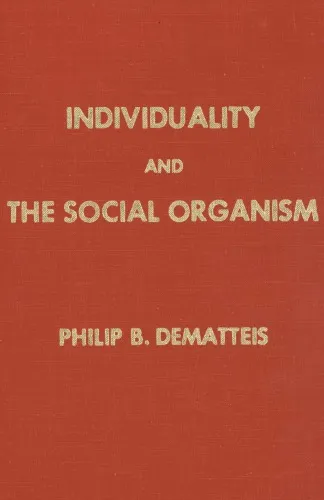
Individuality and the social organism: The controversy between Max Stirner and Karl Marx
Philip Breed Dematteis
1976
View book
Book guide and evaluation
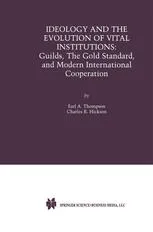
Earl A. Thompson,Charles R. Hickson (auth.)
0 reviews
Published
pages
views
Introduction to "Ideology and the Evolution of Vital Institutions" Ideology and the Evolution of Vital Institutions: Guilds, The Gold Standard, and Modern International Cooperation explores the intricate interplay between ideological paradigms and the formation, evolution,
Before you read
Ideology and the Evolution of Vital Institutions: Guilds, The Gold Standard, and Modern International Cooperation explores the intricate interplay between ideological paradigms and the formation, evolution, and eventual obsolescence of crucial societal institutions. Written with depth and clarity, the book offers a comprehensive investigation into how historical and modern institutions evolve in response to changing sociopolitical ideologies and the economic pressures underpinning them.
This book provides readers with an engaging exploration of economic history and institutional development by focusing on three pivotal systems: medieval guilds, the gold standard, and modern international cooperation mechanisms like those embodied by global organizations. Each of these institutions is carefully unpacked, examined for its ideological origins, and analyzed within its historical context to better understand its evolution and eventual demise or transformation. By delving deep into these case studies, the book provides a compelling commentary on how human thought and collective action shape the world around us.
With a multidisciplinary approach, Ideology and the Evolution of Vital Institutions masterfully blends insights from economics, political science, history, and sociology. Whether you're an academic, a policymaker, or a curious reader looking to better understand the forces shaping critical societal structures, this book is a valuable resource for exploring the complex dynamics of ideology and institutional development.
At its heart, the book focuses on three critical systems: guilds in the medieval period, the gold standard of the modern era, and international cooperation mechanisms that shape present-day global governance. Each institution is treated as an example of how ideologies not only inspire their foundation but also constrain their operations and influence their eventual decline:
These case studies collectively provide an insightful commentary on the ideological tenets behind institutional developments while offering a broader understanding of the connection between institutional evolution and historical change.
"Ideology, whether rigid or flexible, serves as the scaffolding upon which human institutions are erected—and simultaneously, the chains which constrain their evolution."
"History teaches us that institutional obsolescence is rarely about inefficiency but rather a failure to adapt to new ideological demands."
"The strength of an institution lies not just in its design but in its ability to transcend the ideological limitations of its founding."
In an age where institutions face increasing scrutiny and rigid ideologies prompt polarized global debates, this book sheds light on the nuances of institutional endurance. It is a testament to the power of collective human thought, showing how ideology shapes the institutions we depend upon for societal, economic, and political stability.
Scholars, policymakers, and curious readers alike will find the insights of Ideology and the Evolution of Vital Institutions invaluable for understanding the cyclical nature of institutional life. Its lessons encourage readers to consider the ideological roots of today’s systems and question whether these structures are adaptable enough to meet future challenges. By doing so, the book equips its audience with the philosophical and historical tools necessary to contribute toward creating robust and equitable institutions for the modern era.
Your question is answered in the context of this title and author. Each answer uses 2 points.
0 reviews, 4.5 average out of 5
Sign in to publish a review.
Ask a focused question and learn from the community.
Related references that continue this learning path.
Philip Breed Dematteis

Robert J. Aumann,Lloyd S. Shapley (auth.),Nimrod Megiddo (eds.)