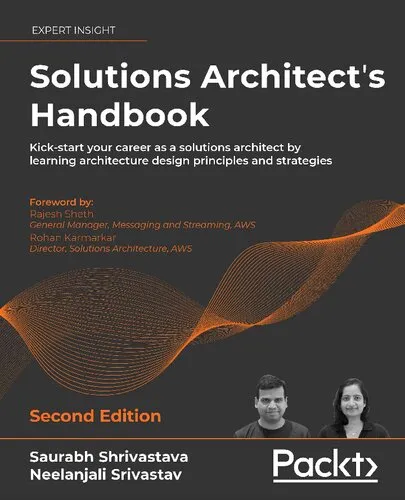
Solutions Architect's Handbook: Kick-start your career as a solutions architect by learning architecture design principles and strategies, 2nd Edition
Saurabh Shrivastava,Neelanjali Srivastav
2022
View book

Book guide and evaluation
M. A. Skorobogatov
0 reviews
Published
pages
views
Hydrotechnical Constructionpp.197—201 hydrotechnical engineering, water infrastructure design Authoritative insights from Hydrotechnical Constructionpp.197—201 on advanced engineering concepts and practical applications. Analytical Summary The book Hydrotechnical Constructi
Before you read
The book Hydrotechnical Constructionpp.197—201 represents a focused segment within a larger technical discourse, concentrating on nuanced engineering challenges and solutions related to hydrotechnical projects. For readers engaged in the design, analysis, and maintenance of hydraulic and water infrastructure, these pages offer a concentrated, detail-rich discussion unparalleled in specificity and practical value.
Each section is crafted to address the complex interplay between theoretical engineering principles and on-the-ground realities. Themes such as fluid mechanics, structural integrity under hydrodynamic load, sediment management strategies, and resilience against environmental stressors emerge as critical pillars. While the broader publication’s historical and technical context may be spread across multiple chapters, pages 197–201 particularly highlight procedural and evaluative frameworks essential for practitioners.
Information regarding the exact publication year is unavailable due to no reliable public source confirming it. However, the author M. A. Skorobogatov’s work here reflects authoritative expertise, bridging academic rigor with practical recommendations that align with current professional standards in hydrotechnical engineering.
From Hydrotechnical Constructionpp.197—201, readers can distill actionable insights that transcend theoretical models, providing guidelines adaptable to diverse projects ranging from dam reinforcement to canal design.
One of the key strengths of this segment lies in its ability to integrate hydrotechnical engineering theory with field data, ensuring recommendations are both technically sound and operationally feasible. The discussions embrace multi-disciplinary viewpoints, incorporating hydrology, materials engineering, and environmental science considerations.
Secondary themes, such as water infrastructure design optimizations, highlight the need for resilience planning in the face of climate variability. Detailed procedural outlines serve as invaluable templates for professionals seeking to minimize risk and maximize efficiency in resource-intensive projects.
“Sound hydrotechnical design is a balance between nature’s force and human ingenuity.”Unknown
“Every water infrastructure project begins with a respect for the currents we seek to harness.”Unknown
Hydrotechnical Constructionpp.197—201 is significant not only as a technical resource but as a bridge between academic research and industry practice.
Its concentrated coverage provides readers with precision-focused knowledge relevant for complex projects where stakes are high and error margins minimal. By emphasizing adaptable methodologies, it ensures applicability across varying scales and geographies.
In a domain where innovation and tradition constantly negotiate space, this segment equips professionals and academics with the necessary vocabulary and conceptual toolkit to contribute meaningfully to future hydrotechnical milestones.
For professionals, scholars, and students, engaging with Hydrotechnical Constructionpp.197—201 is an invitation to deepen their acuity in hydrotechnical engineering and water infrastructure design.
By synthesizing theoretical knowledge with practical insight, these pages stand as a beacon for anyone invested in advancing the state of water-related engineering projects. Whether you aim to apply these lessons to a current undertaking or to enrich academic dialogue, the structured approaches detailed here will serve as dependable companions.
Take the next step—read, share, and discuss this specialized segment. Your engagement will not only broaden your own perspective but also contribute to the collective progress of the field.
Your question is answered in the context of this title and author. Each answer uses 2 points.
0 reviews, 4.2 average out of 5
Sign in to publish a review.
Ask a focused question and learn from the community.
Related references that continue this learning path.
Saurabh Shrivastava,Neelanjali Srivastav
Saurabh Shrivastava,Neelanjali Srivastav