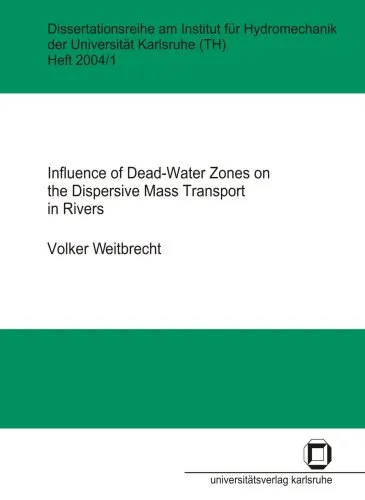
Influence of Dead-Water-Zones on the Dispersive Mass Transport of Rivers
Volker Weitbrecht
2009
View book

Book guide and evaluation
Cheng, Chun-Tian; Chau, K. W.; Li, Xiang-Yang; Li, Gang
0 reviews
Published
pages
views
Welcome to the introduction of Hydrological Sciences Journalpp.11, an insightful and comprehensive book authored by Cheng, Chun-Tian; Chau, K. W.; Li, Xiang-Yang; and Li, Gang. This book delves deep into the dynamic and ever-evolving field of hydrological sciences, offering inn
Before you read
Welcome to the introduction of Hydrological Sciences Journalpp.11, an insightful and comprehensive book authored by Cheng, Chun-Tian; Chau, K. W.; Li, Xiang-Yang; and Li, Gang. This book delves deep into the dynamic and ever-evolving field of hydrological sciences, offering innovative approaches and compelling discussions designed to engage readers from diverse academic and professional backgrounds. Whether you are a researcher, a student, or a policymaker, this work will inspire and challenge you to explore the intricacies of hydrology and its critical impact on our planet.
Hydrological Sciences Journalpp.11 is centered on the study of water systems, their behaviors, and the challenges posed by climatic and anthropogenic factors. The book systematically explores fundamental concepts, such as hydrological processes, data modeling, and environmental sustainability, while integrating advanced methodologies like machine learning and artificial intelligence. These tools are presented as solutions to complex problems in hydrology, such as flood prediction, water resource management, and sustainable planning.
Throughout its varied chapters, the book addresses contemporary challenges. Topics such as the human impact on water systems, the relevance of hydrological research in urban planning, and the necessity of transdisciplinary approaches are thoughtfully analyzed. It emphasizes the importance of maintaining equilibrium in global water cycles to reduce environmental risks and ensure sustainable development.
"Water is not just a substance we consume; it is the very foundation of life and the gateway to sustainable progress."
"In the realm of hydrology, innovation is driven by necessity—the need to preserve, protect, and prosper."
Hydrological Sciences Journalpp.11 stands as a critical resource in understanding not only the science behind water systems but also their broader implications for humanity and the environment. With water shortages and climate emergencies escalating worldwide, this book contributes significantly to the ongoing conversation on sustainable management and disaster mitigation. Its rich blend of theoretical insights and practical methodologies serves as a guide for scientists, engineers, and decision-makers.
The authors—a team of renowned experts—bring their experience and expertise to the forefront, blending rigorous academic research with real-world applications. Readers are empowered to think critically, innovate, and collaborate across disciplines to address pressing hydrological challenges. By reading this book, you will gain actionable insights and deep knowledge about one of the most critical resources on Earth: water.
Your question is answered in the context of this title and author. Each answer uses 2 points.
0 reviews, 3.9 average out of 5
Sign in to publish a review.
Ask a focused question and learn from the community.
Related references that continue this learning path.
Volker Weitbrecht
Subhasish Dey (auth.)

Zhao-Yin Wang,Joseph H. W. Lee,Charles S. Melching (auth.)