
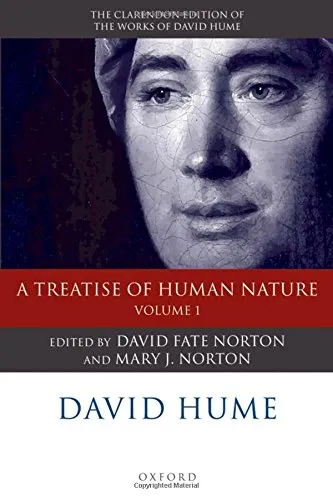
David Hume: A Treatise of Human Nature: Volume 1: Texts
David Hume,David Fate Norton,Mary J. Norton
2007
View book
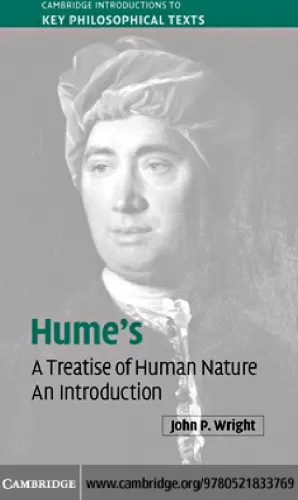
Book guide and evaluation
John P. Wright
0 reviews
Published
pages
views
Introduction to 'Hume’s ’A Treatise of Human Nature’: An Introduction' Welcome to the insightful exploration of David Hume's seminal work, 'A Treatise of Human Nature'. This book serves as a comprehensive introduction, designed to elucidate the complex ideas laid out by
Before you read
Welcome to the insightful exploration of David Hume's seminal work, 'A Treatise of Human Nature'. This book serves as a comprehensive introduction, designed to elucidate the complex ideas laid out by Hume in his quest to unravel the intricacies of human nature. Written with clarity and thoughtfulness, 'Hume’s ’A Treatise of Human Nature’: An Introduction' is your guide to understanding one of the greatest works of philosophy.
'Hume’s ’A Treatise of Human Nature’: An Introduction' carefully dissects the three core parts of Hume's original text: the understanding, the passions, and morals. Starting with the interaction between impressions and ideas, the book guides readers through Hume's arguments on causation, perception, and the self, illustrating his shift from rationalism to empiricism. The section on the passions explores Hume’s view of human emotions and their central role in influencing behavior. Finally, the discussion on morals presents his naturalistic approach to ethics and the principles of human freedom and responsibility. These sections collectively demonstrate Hume's attempt to lay the foundations of all science on a study of human nature.
This book highlights several essential lessons from Hume's 'A Treatise of Human Nature':
Here are some of the key quotes from the book 'Hume’s ’A Treatise of Human Nature’: An Introduction' that capture the essence of Hume's philosophy:
"Reason is, and ought only to be the slave of the passions, and can never pretend to any other office than to serve and obey them."
"Custom, then, is the great guide of human life. It is that principle alone which renders our experience useful to us, and makes us expect, for the future, a similar train of events with those which have appeared in the past."
'Hume’s ’A Treatise of Human Nature’: An Introduction' is not just a reiteration of philosophical tenets but a necessary tool for students and enthusiasts seeking to penetrate the complex and profound ideas proposed by Hume. It systematically narrows down the elaborate notions into digestible content without forfeiting depth or insight.
The book is pivotal in presenting Hume's cognitive landscape, where he challenges perceptions and established doctrines, laying the cornerstone for modern cognitive science and psychology. Furthermore, by prompting critical thinking about the origin and validity of human knowledge, it offers readers an engaging educational experience that underscores the perpetual relevance of philosophical inquiry in understanding human behavior and societal norms.
Your question is answered in the context of this title and author. Each answer uses 2 points.
0 reviews, 4.5 average out of 5
Sign in to publish a review.
Ask a focused question and learn from the community.
Related references that continue this learning path.
David Hume,David Fate Norton,Mary J. Norton

Giovanna Corsi,Maria Luisa Dalla Chiara,Gian Carlo Ghirardi (Editors)
Jay F. Rosenberg
Michael Epperson,Elias Zafiris