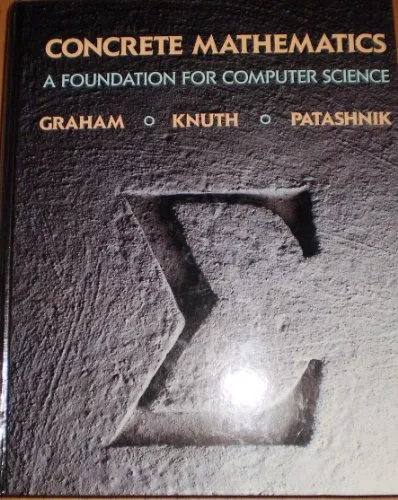
Concrete Mathematics: A Foundation for Computer Science
Ronald L. Graham,Donald Knuth,Oren Patashnik
1988
View book
Book guide and evaluation
G. Polya
0 reviews
Published
pages
views
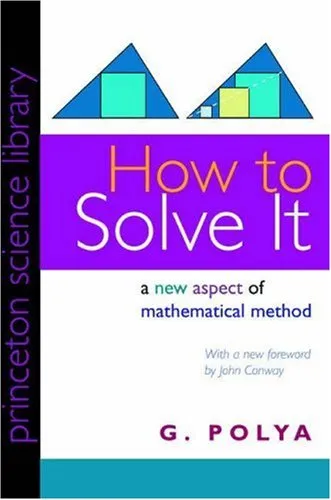
How to Solve It: A New Aspect of Mathematical Method Problem-solving strategies, mathematical reasoning Discover timeless techniques in How to Solve It: A New Aspect of Mathematical Method for effective problem-solving and logical thinking. Analytical Summary Written by the
Before you read
Written by the eminent mathematician George Pólya, How to Solve It: A New Aspect of Mathematical Method stands as a landmark in the art and science of problem-solving. First published in 1945, this influential work transcends mathematics, offering insights applicable to various fields where structured thinking and analytic reasoning are essential. It is revered not only for its practical heuristic techniques but also for its unique ability to make abstract concepts accessible to learners at all levels.
In the book, Pólya introduces a practical four-step approach to tackling problems: understanding the problem, devising a plan, carrying out the plan, and reviewing the process. This method bridges the gap between theoretical knowledge and actionable solutions, offering guidance that remains relevant decades after its first publication. With a lucid narrative and abundant examples, the author showcases how mathematical reasoning can illuminate the way forward in diverse problem contexts.
The text’s enduring appeal lies in its universality. Whether the reader is an academic, a professional engineer, a scientist, or a decision-maker in any domain, Pólya’s methodology fosters clear thinking and persistence. It brings rigor to creative problem-solving, making it a cornerstone reference for serious readers committed to mastering the discipline of structured analysis.
The core lessons from How to Solve It: A New Aspect of Mathematical Method extend beyond equations into the heart of systematic inquiry. Each takeaway equips readers with tools to dissect complexity and build solutions with confidence.
Firstly, the four-step framework encourages an iterative approach: revisiting and refining ideas is not a weakness but a critical part of success. Secondly, asking the right questions often reveals the path to a solution more reliably than immediate calculation. Thirdly, analogies and pattern recognition amplify the problem-solver’s ability to connect disparate ideas. Fourthly, reflection deepens learning, transforming each solved problem into a future asset. Finally, the book reinforces that mathematical reasoning is a discipline that enhances judgment across all decision-making scenarios.
“If you can't solve a problem, then there is an easier problem you can solve: find it.” George Pólya
“You have to guess. If you guess wrong, guess again.” Unknown
“Solving problems is a practical art, like swimming or skiing.” George Pólya
How to Solve It: A New Aspect of Mathematical Method remains a foundational resource for understanding how human thought processes can be guided into productive, logical courses of action. Its methodologies are enduring because they address fundamental cognitive steps that transcend cultures, disciplines, and eras.
In academic settings, Pólya’s strategies form a scaffold for both teaching and learning, ensuring that knowledge is absorbed actively rather than passively. In professional contexts, these principles translate into sharper project planning, better troubleshooting, and improved decision-making. The book is a reminder that true mastery comes from meta-thinking: not just solving a particular problem, but refining the process of problem-solving itself. Even in an age of digital tools and machine learning, humans benefit profoundly from these timeless approaches.
For those who seek precision, clarity, and adaptability in thought, How to Solve It: A New Aspect of Mathematical Method offers both a roadmap and an invitation. Its pages encourage continual growth, reminding readers that each problem is an opportunity to sharpen skills and expand knowledge.
You are invited to explore the book’s wisdom, share its insights within your academic and professional circles, and engage in discussions that keep its principles alive. Embrace Pólya’s approach not just as a reference, but as a practice woven into your daily analytical challenges. In doing so, you honor a tradition of thoughtful problem-solving that remains as relevant today as the day it was first articulated.
Your question is answered in the context of this title and author. Each answer uses 2 points.
0 reviews, 4.6 average out of 5
Sign in to publish a review.
Ask a focused question and learn from the community.
Related references that continue this learning path.
Ronald L. Graham,Donald Knuth,Oren Patashnik