

Book guide and evaluation
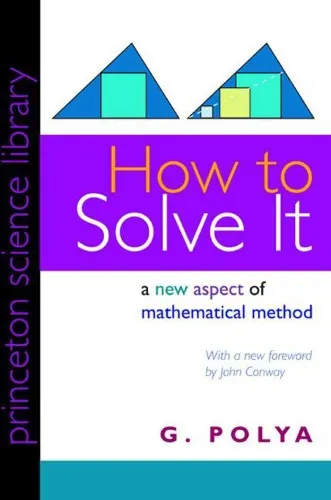
How to Solve It: A New Aspect of Mathematical Method (Princeton Science Library)
G. Polya
English
Beginner
novel
4.7 / 5
0 reviews
2004
Published
284
pages
371
views
Introduction to "How to Solve It: A New Aspect of Mathematical Method" "How to Solve It" by George Pólya is a groundbreaking work that has transformed the way students, educators, and problem-solvers approach the art of thinking. First published in 1945, this book has stoo
Before you read
What will you get from this book?
Introduction to "How to Solve It: A New Aspect of Mathematical Method"
"How to Solve It" by George Pólya is a groundbreaking work that has transformed the way students, educators, and problem-solvers approach the art of thinking. First published in 1945, this book has stood the test of time as an essential resource that bridges the gap between mathematics, logic, and human reasoning. With its universal methods and strategies, the book empowers its readers to analyze problems, devise solutions, and cultivate a structured way of thinking in both mathematics and real-world challenges. Whether you are a mathematician, an educator, or someone intrigued by the problem-solving process, this book will challenge and illuminate your approach to thinking critically.
Detailed Summary of the Book
At its core, "How to Solve It" is an exploration of the process of problem-solving. Pólya's focus lies not on providing rigid formulas or answers but on guiding readers through a series of principles, heuristics, and mental frameworks that enhance their ability to effectively tackle any problem. The framework revolves around a four-step process:
- Understand the Problem: The first and most crucial step is comprehending the problem. Pólya emphasizes asking critical questions, such as: What is being asked? What data is available? Is there enough information to solve it?
- Devise a Plan: Once you understand the problem, the next step is to formulate a strategy. Here, Pólya introduces heuristics like drawing diagrams, considering related problems, or applying similar solutions from past experiences.
- Carry Out the Plan: This is where the heart of problem-solving lies—executing the solution with precision. Pólya advises remaining flexible and correcting course if necessary to deal with unexpected complications.
- Review the Solution: In this final stage, problem-solvers analyze their results, reflect on the process, and identify areas of improvement to hone their problem-solving techniques further.
Beyond these steps, the book is filled with real-world examples, detailed explanations, and practicality. Pólya provides rich insights into the creative side of mathematics, encouraging readers to approach problems with curiosity instead of frustration. The conversational tone and universal application of ideas make it accessible and deeply profound for a global audience.
Key Takeaways
- Problem-solving is a process: Success often lies in understanding the method and not just focusing on the solution.
- Questions are powerful tools: Asking the right questions is key to analyzing and breaking down complex problems.
- Methods like working backward, looking for patterns, or simplifying the problem are universal heuristics.
- Reflection and learning from failed attempts are integral to improving one's problem-solving abilities.
Famous Quotes from the Book
"A great discovery solves a great problem but there is a grain of discovery in the solution of any problem."
"If you can’t solve a problem, then there is an easier problem you can solve: find it."
"Solving problems is a practical art, like swimming, cycling, or skiing. You learn it by imitation and practice."
Why This Book Matters
"How to Solve It" is not just a book about mathematics; it is a manifesto for structured reasoning and critical thinking. Its impact transcends generations, influencing fields as diverse as education, computer science, philosophy, and engineering. The principles taught in the book are timeless, offering readers tools to think more clearly and approach challenges more effectively. For students, it serves as a guide to mastering mathematics; for teachers, it is a foundational text on pedagogy, and for professionals, it becomes a resource for innovative and efficient problem-solving.
In an era where critical thinking and decision-making are more important than ever, Pólya’s work remains profoundly relevant. It inspires readers to embrace curiosity, nurture creative thinking, and rigorously analyze problems in all walks of life. This book is not merely about mathematics—it is about cultivating a mindset for lifelong learning and intellectual growth.
Ask this book
Your question is answered in the context of this title and author. Each answer uses 2 points.
Sign in to ask the book assistant.
Reader reviews
0 reviews, 4.7 average out of 5
No reviews yet
If you have read this book, help the next reader with your experience.
Write a review
Sign in to publish a review.
Reader questions and answers
Ask a focused question and learn from the community.
Sign in to ask or answer a question.
No questions yet
Be the first to ask a clear, useful question.
What to read next
Related references that continue this learning path.


Modern Computer Vision with PyTorch: A Practical Roadmap From Deep Learning Fundamentals to Advanced Applications and Generative AI, 2nd Edition
V Kishore Ayyadevara,Yeshwanth Reddy
2023
View book