Social Media Analytics Strategy: Using Data to Optimize Business Performance
Alex Gonçalves (auth.)
2017
View book
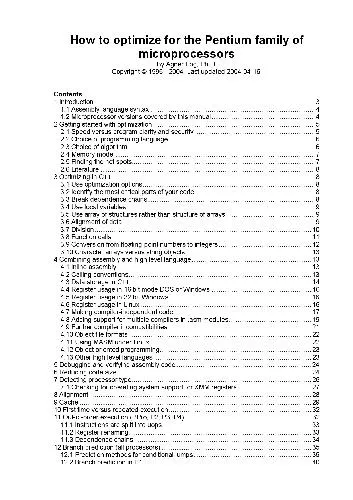
Book guide and evaluation
Fog A.
0 reviews
Published
pages
views
Introduction Welcome to "How to Optimize for the Pentium Family of Microprocessors"! This book serves as a comprehensive guide for software developers, computer engineers, and performance enthusiasts who are eager to push the limits of the Pentium family of processors. With cu
Before you read
Welcome to "How to Optimize for the Pentium Family of Microprocessors"! This book serves as a comprehensive guide for software developers, computer engineers, and performance enthusiasts who are eager to push the limits of the Pentium family of processors. With cutting-edge strategies, in-depth analysis, and practical scenarios, this book is your ultimate handbook for achieving unparalleled efficiency and performance optimization across a variety of Pentium-based systems.
Optimization has always been a critical pillar of software development. With constantly increasing demands for performance in computational tasks, video processing, simulations, gaming, and multitasking, understanding the intricacies of the hardware and tailoring software to maximize capabilities has never been more important. The Pentium family of microprocessors—an architectural leap in computing from Intel—bridges the gap between flexibility, raw power, and parallelism. This book dives deep into these core features, offering a step-by-step approach to mastering optimization techniques.
This introduction sets the stage by detailing the book’s structure, key areas of focus, and the benefits it brings to readers who wish to outshine in a highly competitive technological landscape. Let's explore what lies ahead in this journey.
"How to Optimize for the Pentium Family of Microprocessors" provides a balanced mix of theory, practical instruction, and real-world examples.
Over the course of the book, readers will first gain a foundational understanding of the core architectural principles behind the Pentium processors. These include concepts such as superscalar execution, pipelining, branch prediction, and dual pipelines. Using this knowledge, the book explains how software applications can be fine-tuned to take advantage of these hardware features.
Through a variety of chapters, you’ll delve into optimization strategies, such as aligning code for instruction caches, minimizing branch mispredictions, effective memory utilization, and leveraging the Pentium’s floating-point unit (FPU). Additionally, compiler-level optimizations, assembly language adjustments, and debugging techniques are presented in a detailed, easy-to-grasp manner.
Each chapter builds on the knowledge gained from preceding sections, culminating in multiple case studies to solidify understanding. By the end of this book, you will be equipped to write high-performance software optimized for the Pentium family and beyond.
“Optimization is not about making things fast arbitrarily; it is the precise art of making them fast where it counts.”
“To truly optimize software for hardware, you must first understand the hardware at a level most are unwilling to uncover.”
“The Pentium processor is a masterpiece of both engineering and compromise—your task as an optimizer is navigating its potential while respecting its limits.”
This book is more than just a technical manual; it’s a blueprint for creating high-performing software on the Pentium platform.
The importance of optimization cannot be understated in a world where performance is directly tied to business outcomes and user satisfaction. The Pentium family of microprocessors marked an era where performance and efficiency became accessible on consumer-level hardware, and this book provides the skills required to harness that power effectively.
Whether you are fine-tuning an existing application to squeeze out the last drops of performance or designing new software systems from scratch, the principles in this book will enable you to create solutions that stand the test of time. Moreover, the level of depth and explanation provided here ensures that you gain transferable skills and understanding, applicable not only to Pentium processors but to other architectures influenced by similar principles.
For those deeply entrenched in the craft of software engineering, this book serves as both a learning tool and a valuable reference. It bridges the gap between theoretical computer science and practical programming, presenting information in a structured way that is both engaging and rewarding.
Your question is answered in the context of this title and author. Each answer uses 2 points.
0 reviews, 4.5 average out of 5
Sign in to publish a review.
Ask a focused question and learn from the community.
Related references that continue this learning path.
Alex Gonçalves (auth.)
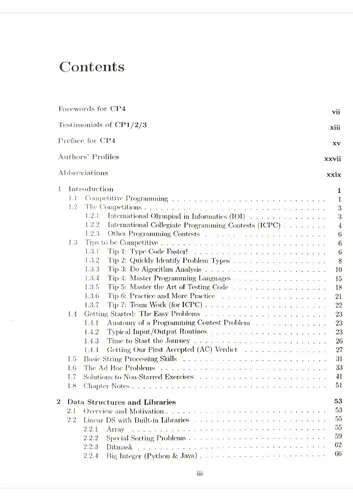
Steven Halim,Felix Halim,Suhendry Effendy