
Book guide and evaluation
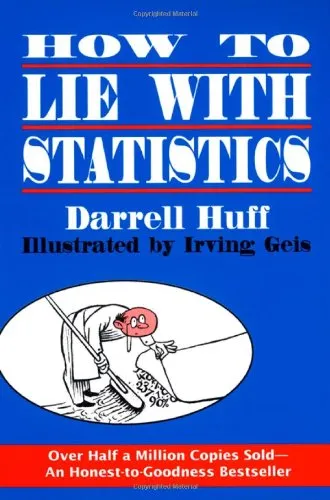
How to Lie With Statistics
Darrell Huff,Irving Geis
English
Beginner
Big Data
4.5 / 5
0 reviews
1993
Published
73
pages
875
views
Introduction to 'How to Lie with Statistics' Written by Darrell Huff and illustrated by Irving Geis, How to Lie with Statistics is a timeless classic that demystifies the art of statistical deception. This book is renowned for unveiling how statistics can be manipulated an
Before you read
What will you get from this book?
Introduction to 'How to Lie with Statistics'
Written by Darrell Huff and illustrated by Irving Geis, How to Lie with Statistics is a timeless classic that demystifies the art of statistical deception. This book is renowned for unveiling how statistics can be manipulated and misrepresented to support any argument or agenda. Through humor and real-world examples, Huff helps readers develop a critical mindset, allowing them to discern truths from the cleverly disguised lies woven through statistics.
Detailed Summary of the Book
Throughout How to Lie with Statistics, Huff explores the myriad ways in which data can be manipulated. Starting with the fundamental components of statistics, he identifies the common techniques used to mislead or confuse audiences—ranging from biased sampling to exploiting averages. The book covers the misuse of graphs and charts where axes can be adjusted to exaggerate trends or hide significant data points. Huff then delves into statistical jargon that is often used to baffle rather than inform, demonstrating how statistical concepts can be twisted to create false impressions.
Each chapter builds upon the other, culminating in a comprehensive guide to understanding and detecting statistical manipulation. Huff emphasizes that statistics are often wielded as weapons to push particular narratives, and only by recognizing these tactics can one wisely navigate the sea of numbers encountered in everyday life.
Key Takeaways
- The Illusion of Objectivity: Statistics often appear neutral and factual, yet the interpretation and presentation can be swayed to serve particular interests.
- Sampling Bias: The importance of asking "who was surveyed?" to detect potential biases in sampling methodologies.
- The Danger of Averages: How averages can be misleading and do not represent the variations within the data set.
- Graphs and Visuals: Visual representations can be manipulated to emphasize certain trends or hide others.
- Understanding Correlation vs. Causation: Recognizing that correlation does not equate to causation is fundamental in interpreting statistics accurately.
Famous Quotes from the Book
“A well-wrapped statistic is better than Hitler’s ‘big lie’; it misleads, yet it cannot be pinned on you.”
“The secret language so common and its macrocosmic cousin, pseudo-statistics, is a powerful personal tool of the statistician.”
Why This Book Matters
How to Lie with Statistics is more relevant than ever in an age overflowing with data and digital content. In a world where data is omnipresent, and decision-making is increasingly data-driven, Huff’s book serves as a critical tool for rooting out misinformation and discerning truth. It empowers readers with the knowledge to question and analyze statistical claims, whether encountered in media reports, advertisements, or during discussions on important social and political issues.
The enduring popularity of Huff’s book underscores the ongoing need for statistical literacy in society. As data becomes an influential tool in shaping opinions and behaviors, the ability to understand and critique statistical information is essential. Huff provides the framework to approach statistics with a rational and skeptical lens, making this book an indispensable guide for anyone wishing to be informed, rational, and conscientious in their engagement with data.
Ask this book
Your question is answered in the context of this title and author. Each answer uses 2 points.
Sign in to ask the book assistant.
Reader reviews
0 reviews, 4.5 average out of 5
No reviews yet
If you have read this book, help the next reader with your experience.
Write a review
Sign in to publish a review.
Reader questions and answers
Ask a focused question and learn from the community.
Sign in to ask or answer a question.
No questions yet
Be the first to ask a clear, useful question.
What to read next
Related references that continue this learning path.
IoT and Big Data Analytics for Smart Cities: A Global Perspective
Sathiyaraj Rajendran,Munish Sabharwal,Gheorghita Ghinea,Rajesh Kumar Dhanaraj,Balamurugan Balusamy
2022
View book
Data Lake Analytics on Microsoft Azure: A Practitioner's Guide to Big Data Engineering
Harsh Chawla,Pankaj Khattar
2020
View book