Book guide and evaluation
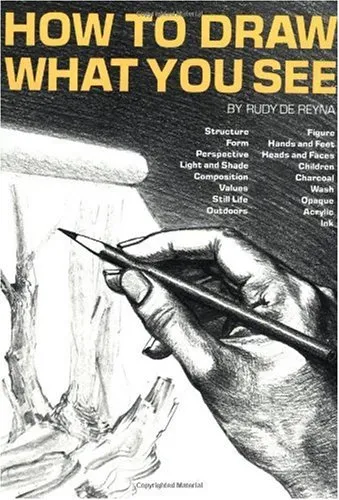
How to draw what you see
Rudy De Reyna
English
Beginner
Painting & Drawing
4.5 / 5
0 reviews
1996
Published
176
pages
759
views
Introduction to 'How to Draw What You See' Welcome to an exploration into the art of drawing with 'How to Draw What You See.' This book is a comprehensive guide designed to bridge the gap between perception and representation, offering techniques to enhance one's artistic
Before you read
What will you get from this book?
Introduction to 'How to Draw What You See'
Welcome to an exploration into the art of drawing with 'How to Draw What You See.' This book is a comprehensive guide designed to bridge the gap between perception and representation, offering techniques to enhance one's artistic abilities by truly understanding and capturing the world as it appears.
Detailed Summary
At its core, 'How to Draw What You See' is more than just a manual for sketching; it is a profound dive into the philosophy of art and the essential skill of observation. This book teaches artists of all levels how to develop an artist’s eye, focusing on the fundamental principles of light, shadow, perspective, and form. By tapping into these principles, readers learn to translate what they see in the real world into lifelike sketches and drawings.
Beginning with the basics, the book invites readers to start simply, observing objects around them with a fresh perspective. Through well-structured and easy-to-follow lessons, it progresses into more complex scenes and subjects. These lessons are carefully crafted to build upon one another, ensuring a solid foundation in drawing techniques.
As the chapters unfold, the book introduces techniques used by master artists, encouraging readers to blend these traditional methods with their own creativity. 'How to Draw What You See' is a journey towards developing personal style and mastery, not only in drawing but in seeing and interpreting the world.
Key Takeaways
- Understanding the fundamental elements of drawing, including shape, form, light, and shadow.
- Developing the skill to transform three-dimensional observations into two-dimensional representations.
- Building the artist's ability to see the world through a creative lens, enhancing visual memory and detail orientation.
- Encouraging exploration of different mediums and styles to find a unique artistic voice.
Famous Quotes from the Book
"Sketching is a way of seeing more clearly, allowing your hands and eyes to blend the essence of reality onto paper."
"Every artist was first an amateur, but those who see beyond their initial perceptions find the heart of creativity."
Why This Book Matters
'How to Draw What You See' stands out as a seminal text in art education. It matters because it equips both novices and experienced artists with the tools to see beyond the surface. For beginners, it demystifies the intimidating task of beginning to draw by breaking it down into accessible steps. For seasoned artists, it offers new ways to refine and hone observational skills.
Not merely a how-to book, it's an invitation to engage with the visual world deeply and thoughtfully. By emphasizing observation as much as technique, the book highlights a philosophy that drawing starts not with the hand but with the eye. It underscores the importance of ongoing practice and patience, critical for anyone serious about mastering the art of drawing.
Ultimately, 'How to Draw What You See' empowers artists to learn the universal language of art—seeing. This timeless guide has influenced generations of artists, nurturing an appreciation for the art of observation that transcends traditional boundaries, making it an invaluable resource in any artist's library.
Ask this book
Your question is answered in the context of this title and author. Each answer uses 2 points.
Sign in to ask the book assistant.
Reader reviews
0 reviews, 4.5 average out of 5
No reviews yet
If you have read this book, help the next reader with your experience.
Write a review
Sign in to publish a review.
Reader questions and answers
Ask a focused question and learn from the community.
Sign in to ask or answer a question.
No questions yet
Be the first to ask a clear, useful question.
What to read next
Related references that continue this learning path.
The idea of a theater study of ten plays, the art of drama in changing perspective
Fergusson,Francis
1972;1968
View book