

Book guide and evaluation
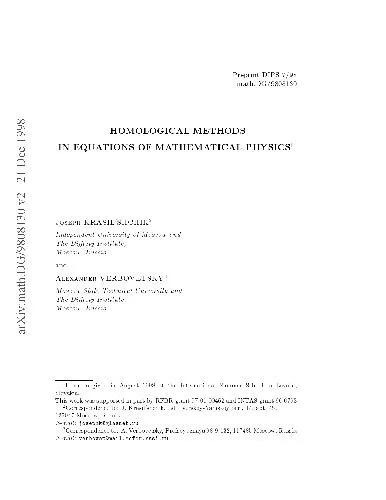
Homological methods in equations of mathematical physics
Krasil'shchik J.,Verbovetsky A.
English
Beginner
Mathematical Analysis
4.3 / 5
0 reviews
1998
Published
150
pages
486
views
Welcome to the rich and complex world of 'Homological Methods in Equations of Mathematical Physics'. In this book, we explore cutting-edge methods at the interface of mathematics and physics, using homological approaches to solve and understand the underlying equations that des
Before you read
What will you get from this book?
Welcome to the rich and complex world of 'Homological Methods in Equations of Mathematical Physics'. In this book, we explore cutting-edge methods at the interface of mathematics and physics, using homological approaches to solve and understand the underlying equations that describe physical phenomena.
Summary of the Book
Our book delves into the deep connections between homological algebra and equations used in mathematical physics. Rooted in abstract mathematical frameworks, the text makes essential theoretical concepts accessible to those working within both fields. Initially, we lay a concise foundation of homological algebra, introducing critical concepts such as chain complexes, homological invariants, and cohomology theories. These are then intricately connected to physical theories, like classical mechanics, quantum field theory, and general relativity.
Throughout the chapters, you will find a progression from simple to complex applications, dissecting how homological methods can elucidate the structure of differential equations that are pivotal in modeling physical phenomena. Topics such as the role of symmetries and conservation laws, as captured through Noether’s theorem and Lie derivatives, are discussed in depth. The integration of practical examples and a step-by-step approach aids in demystifying advanced mathematical constructs for physicists and mathematicians alike.
Key Takeaways
- Understanding the fundamental principles of homological algebra and their applications in physics.
- Developing the ability to translate complex physical problems into homological terms and vice versa.
- Grasping the importance of categorical language in organizing and solving equations of mathematical physics.
- Insight into the modern approaches of handling cohomological techniques within the scope of differential equations.
Famous Quotes from the Book
"In the symphony of equations, homology acts as the subtle undertone, revealing the hidden harmonics of physical truth."
"The language of homological methods is universal, bridging the abstract realms of mathematics with the tangible realities of physics."
Why This Book Matters
In an era where the demarcation between disciplines is blurring, 'Homological Methods in Equations of Mathematical Physics' stands as a paradigm of interdisciplinary study. This book is crucial for researchers who wish to explore the far-reaching implications of homology in physics. By providing a robust pedagogical approach, this text serves as both a reference and a guideline for advanced studies and research in mathematical physics.
Furthermore, the book is significant for motivating new methodologies that arise when rigorous mathematical techniques are applied to physical contexts, offering fresh insights and inspiring innovations that could lead to breakthroughs in how we understand the natural world.
The favored narrative in this book encourages an intellectual pursuit that extends beyond traditional boundaries, ensuring that readers come away with a deeper appreciation of the unity between mathematics and physics. It challenges academics to rethink approaches to problem-solving in these fields, ushering in an era where interdisciplinary methodologies are not the exception, but the norm.
Ask this book
Your question is answered in the context of this title and author. Each answer uses 2 points.
Sign in to ask the book assistant.
Reader reviews
0 reviews, 4.3 average out of 5
No reviews yet
If you have read this book, help the next reader with your experience.
Write a review
Sign in to publish a review.
Reader questions and answers
Ask a focused question and learn from the community.
Sign in to ask or answer a question.
No questions yet
Be the first to ask a clear, useful question.
What to read next
Related references that continue this learning path.

Frontiers in Functional Equations and Analytic Inequalities
George A. Anastassiou,John Michael Rassias
2019
View book
Functional Equations and Inequalities: Solutions and Stability Results
K Ravi;B V Senthil Kumar;John Michael Rassias
2017
View book
Partial Differential Equations: An Introduction to a General Theory of Linear Boundary Value Problems
Aleksei A. Dezin (auth.)
1987
View book