

Book guide and evaluation
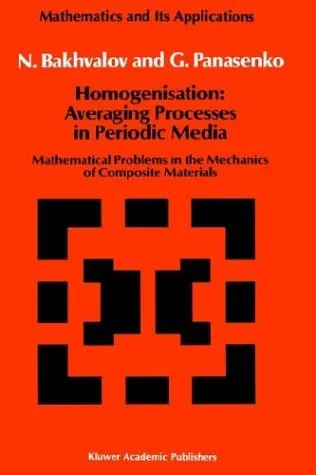
Homogenisation: Averaging Processes in Periodic Media: Mathematical Problems in the Mechanics of Composite Materials (Mathematics and its Applications)
N.S. Bakhvalov,G. Panasenko
English
Beginner
Mathematics
4.4 / 5
0 reviews
1989
Published
402
pages
157
views
Introduction to Homogenisation: Averaging Processes in Periodic Media Homogenisation: Averaging Processes in Periodic Media: Mathematical Problems in the Mechanics of Composite Materials by N.S. Bakhvalov and G. Panasenko is a foundational text addressing one of the centra
Before you read
What will you get from this book?
Introduction to Homogenisation: Averaging Processes in Periodic Media
Homogenisation: Averaging Processes in Periodic Media: Mathematical Problems in the Mechanics of Composite Materials by N.S. Bakhvalov and G. Panasenko is a foundational text addressing one of the central challenges in applied mathematics and mechanics—the homogenisation of physical processes in periodic media. The book serves as a comprehensive guide for understanding the underlying mathematical framework and physical intuition required to model complex composite materials. Written for researchers, engineers, and graduate students, it delves into the interplay between mathematical theory and its practical applications in solving real-world problems in materials science, elasticity, fluid mechanics, and beyond.
Detailed Summary of the Book
The book lays a meticulous foundation in the mathematical theory of homogenisation, a powerful averaging process used to study complex systems where multiscale properties are inherent. It addresses the problem of modelling structures like composite materials by simplifying their intricate periodic microstructure while retaining the essential macroscopic behavior. The authors adopt a rigorous yet accessible approach, starting from basic principles and building up to advanced concepts in mechanics, partial differential equations (PDEs), and asymptotic analysis.
Key topics include periodic structures, effective properties of materials, multi-scale expansions, and boundary-layer effects. The text explains the derivation of governing equations for composite materials in periodic settings, allowing readers to grasp how microscopic properties influence the macroscopic behavior of the system. It provides insights into real-world applications, such as studying the elasticity and conductivity of heterogeneous materials and analyzing fluid flow in porous media.
Each chapter is carefully structured to guide readers through theoretical discussions, followed by examples and problem sets designed to consolidate understanding. The authors emphasize mathematical rigor, ensuring that readers develop a strong analytical foundation while appreciating the practical implications of homogenisation techniques in engineering and materials science.
Key Takeaways
This book offers several critical takeaways for those interested in the mechanics of composite materials and the mathematical principles of homogenisation:
- A deep understanding of multi-scale methods and their role in simplifying complex systems with periodic microstructures.
- Detailed derivations of asymptotic expansions and homogenised equations, equipped to tackle both linear and nonlinear problems.
- Clear presentation of the connection between microstructural features and macroscopic material behavior, from conductivity to elasticity.
- Practical techniques for applying homogenisation methods across disciplines, including fluid mechanics, thermodynamics, and physics.
- A rich theoretical framework backed by illustrative examples and exercises for domain-specific applications.
By mastering these principles, readers will be equipped to simplify the analysis of periodic structures and model composite materials with greater accuracy and efficiency.
Famous Quotes from the Book
While the book's technical focus might not lend itself directly to quotable prose, its pages are filled with insights that resonate with scholars in mechanics and applied mathematics. Here are a few particularly impactful passages:
"The art of homogenisation lies in bridging the gap between the microscopic irregularities of a material and its smooth, averaged macroscopic behavior."
"In every periodic system, the challenge lies not in simplicity, but in revealing the order beneath complexity."
Why This Book Matters
The importance of this book cannot be overstated, as it addresses a critical challenge in the mechanics of materials. Composite materials are increasingly relevant in modern engineering, from aerospace and automotive industries to biomedical applications. However, their inherent complexity, due to periodic microstructures, poses significant challenges in analysis and modeling.
By introducing readers to the powerful mathematical techniques of homogenisation, Bakhvalov and Panasenko provide the tools needed to unlock the potential of these materials. The book equips engineers and scientists with the mathematical rigor and intuition required to solve pressing problems involving composite materials, making it an indispensable resource.
Moreover, for mathematicians, the text offers an in-depth exploration of homogenisation as a field of applied mathematics, showcasing its versatility in solving PDEs and addressing multi-scale challenges. It bridges the gap between theoretical results and practical implementation, making it equally appealing to academics and practitioners.
Ultimately, this book has become a cornerstone for researchers and students alike, fostering advancements in the development and utilization of composite materials in science and technology.
Ask this book
Your question is answered in the context of this title and author. Each answer uses 2 points.
Sign in to ask the book assistant.
Reader reviews
0 reviews, 4.4 average out of 5
No reviews yet
If you have read this book, help the next reader with your experience.
Write a review
Sign in to publish a review.
Reader questions and answers
Ask a focused question and learn from the community.
Sign in to ask or answer a question.
No questions yet
Be the first to ask a clear, useful question.
What to read next
Related references that continue this learning path.


Modern Computer Vision with PyTorch: A Practical Roadmap From Deep Learning Fundamentals to Advanced Applications and Generative AI, 2nd Edition
V Kishore Ayyadevara,Yeshwanth Reddy
2023
View book