Understanding Soft Condensed Matter Via Modeling and Computation (Series in Soft Condensed Matter 3)
Wenbing Hu,An-Chang Shi,Editors
2010
View book
Book guide and evaluation
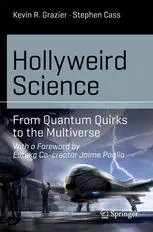
Kevin R. Grazier,Stephen Cass (auth.)
0 reviews
Published
pages
views
Introduction to "Hollyweird Science: From Quantum Quirks to the Multiverse" Welcome to the fascinating universe of "Hollyweird Science: From Quantum Quirks to the Multiverse," a book that bridges the gap between mind-bending real-world science and the wildly imaginative in
Before you read
Welcome to the fascinating universe of "Hollyweird Science: From Quantum Quirks to the Multiverse," a book that bridges the gap between mind-bending real-world science and the wildly imaginative interpretations of it in Hollywood's movies and TV shows. Authored by two distinguished science communicators, Kevin R. Grazier and Stephen Cass, this book delves into the interplay of science fiction and scientific reality.
Have you ever wondered how scientifically accurate your favorite sci-fi films and shows actually are? Or how far filmmakers go to balance entertainment with realism? This book explores these questions and more, taking the reader on an intellectual and entertaining journey through depictions of quantum physics, cosmology, robotics, multiverses, and advanced technologies in Hollywood productions.
By combining expertise in real science with a passion for storytelling, the authors shed light on how the entertainment industry borrows, twists, or occasionally outright discards scientific principles for the sake of drama, spectacle, and narrative coherence. Along the way, "Hollyweird Science" brings to the forefront the importance of science literacy in today's pop culture-driven world.
"Hollyweird Science" begins by addressing how science fiction has captivated audiences for generations, inspiring not just wonder but actual innovation in technology and science. Grazier and Cass dive into both historical and modern examples, showcasing how speculative fiction has influenced real-world advancements and vice versa.
The book moves through various thematic explorations, beginning with the depiction of quantum mechanics and multiverses in media such as "Doctor Who" and "The Flash." What do these narratives get right, and where do they bend the rules of reality? From there, the authors touch on artificial intelligence and robotics as portrayed in works like "Westworld" and "Ex Machina," dissecting how close we are to achieving the sentient machines of our silver-screen fantasies.
Other chapters focus on astrophysics and space travel, looking at classics like "2001: A Space Odyssey" to current blockbusters such as "Interstellar" and the Marvel Cinematic Universe. The authors elucidate the surprising amount of real science embedded in these stories, while also pointing out where significant creative liberties were taken.
Throughout, the book balances accessible language with scientific rigor, unpacking complex concepts in ways that are enlightening to experts and laypeople alike. It also brings in commentary from scientists who have served as consultants for the entertainment industry, revealing behind-the-scenes insights into how science shapes—and is shaped by—Hollywood.
"The multiverse trope in science fiction isn't just a narrative device; it's a mirror reflecting how humanity dreams of the infinite and fears the unknown."
"Every movie set in space has to make a choice: embrace the stark cold of scientific realism, or ignite the boundless flames of imaginative storytelling. Sometimes, the boldest choice is to find a balance."
"Science fiction can serve as a philosophy as much as it entertains—a way for society to question itself and envision a better future."
In an age where science and technology play an increasingly dominant role in shaping the future, public understanding of these fields is critical. Movies and TV shows serve as a powerful medium to inspire curiosity and foster conversations about where humanity is headed. However, they can also perpetuate misunderstandings, which is why a book like "Hollyweird Science" is so essential.
By illustrating where Hollywood thrives and stumbles in its depiction of scientific principles, this book encourages viewers to think critically about the science they see on screen. More than just an analysis of cinematic tropes, "Hollyweird Science" is a celebration of human creativity—showcasing how real-world science and speculative fiction intersect to expand the boundaries of possibility.
Whether you're a science enthusiast, a cinephile, or someone looking to better understand the relationship between pop culture and STEM, "Hollyweird Science" offers a compelling read that entertains while enlightening.
Your question is answered in the context of this title and author. Each answer uses 2 points.
0 reviews, 4.5 average out of 5
Sign in to publish a review.
Ask a focused question and learn from the community.
Related references that continue this learning path.
Wenbing Hu,An-Chang Shi,Editors
Richard P. Feynman,Robert B. Leighton,Matthew Sands
Richard P. Feynman,Robert B. Leighton,Matthew Sands