

Book guide and evaluation
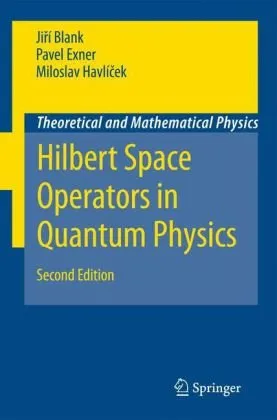
Hilbert Space Operators in Quantum Physics Theoretical and Mathematical Physics
Jirí Blank,Pavel Exner,Miloslav Havlícek
English
Beginner
Physics
4.9 / 5
0 reviews
2008
Published
677
pages
263
views
Introduction to "Hilbert Space Operators in Quantum Physics" Written by Jirí Blank, Pavel Exner, and Miloslav Havlícek, "Hilbert Space Operators in Quantum Physics" is a seminal work that delves into the profound interplay between mathematics and quantum mechanics.
Before you read
What will you get from this book?
Introduction to "Hilbert Space Operators in Quantum Physics"
Written by Jirí Blank, Pavel Exner, and Miloslav Havlícek, "Hilbert Space Operators in Quantum Physics" is a seminal work that delves into the profound interplay between mathematics and quantum mechanics. The book serves as both an introduction and an advanced guide for students, researchers, and professionals seeking to understand the mathematical framework of quantum theory. It offers a comprehensive study of the operators in Hilbert spaces, a cornerstone of quantum mechanics, providing a rigorous yet accessible approach to this crucial topic in theoretical and mathematical physics. By bridging the gap between physics and mathematics, the authors succeed in creating an invaluable resource for those in both disciplines.
From foundational concepts to sophisticated topics, this book covers a wide range of material, presented in a well-structured manner. Its emphasis on clear, precise definitions and logical developments ensures that readers not only grasp the material but also develop an appreciation for the elegant mathematical underpinnings of quantum theory. In this introduction, we explore the main themes, core takeaways, and significance of this remarkable work.
Detailed Summary of the Book
The book begins by laying the groundwork for the mathematical structure of quantum theory, introducing readers to Hilbert spaces, a type of vector space equipped with an inner product. This foundational framework forms the basis for quantum mechanics, providing a natural domain for interpreting wave functions and operators. The initial chapters explore basic properties of Hilbert spaces, such as orthonormal bases, completeness, and projection operators. These concepts are crucial for understanding quantum states, measurements, and the probabilistic nature of quantum mechanics.
Subsequent chapters explore the theory of operators, the mathematical objects that correspond to measurable quantities and dynamical evolutions in quantum systems. The authors introduce bounded, unbounded, and self-adjoint operators, rigorously proving their properties and elucidating their significance in quantum mechanics. Emphasis is placed on the spectral theorem, which connects the concepts of eigenvalues, eigenvectors, and spectral measures with physical observables.
Later sections delve into advanced topics such as the theory of compact operators, trace-class operators, and scattering theory. These topics are essential in contemporary quantum physics, appearing frequently in the study of quantum fields and many-body systems. The authors integrate examples and applications throughout the text, illuminating abstract mathematics with physical relevance.
The book concludes with discussions of specialized topics, including perturbation theory and the interaction picture, showcasing the adaptability of mathematical concepts in quantum-mechanical contexts. These discussions highlight the interplay between mathematical rigor and physical intuition.
Key Takeaways
- Hilbert spaces provide the natural mathematical framework for quantum mechanics, encompassing states, operators, and wave functions.
- Operators in these spaces, particularly self-adjoint and unitary operators, play a central role in defining physical observables and dynamical evolution.
- The spectral theorem establishes a powerful connection between operator theory and measurable quantities in physics.
- Advanced topics such as compact operators and scattering theory extend the reach of operator theory, allowing for in-depth exploration of complex quantum systems.
- Mathematical rigor is essential for a complete understanding of quantum physics, strengthening physical intuition and predictive power.
Famous Quotes from the Book
"The relationship between mathematical logic and physical laws is perhaps nowhere as visible as in the application of operator theory to quantum mechanics."
"Hilbert spaces are not just abstract creations of mathematics—they are the natural languages of the quantum world."
"The spectral properties of operators are as fundamental to quantum physics as the concepts of energy and momentum."
Why This Book Matters
"Hilbert Space Operators in Quantum Physics" occupies a special place in the literature of mathematical physics due to its meticulous balance between mathematical depth and physical relevance. In the age of quantum computation and advanced condensed matter physics, understanding the mathematical structure of quantum mechanics is more crucial than ever. This book equips both physicists and mathematicians with the tools required to tackle complex problems in their respective fields.
The authors' approach ensures that readers gain not just knowledge but also the intellectual framework to critically analyze and extend quantum theory. By building from the ground up, the book is accessible to students while still being comprehensive enough for experts. It has fostered countless breakthroughs by providing a clear and rigorous foundation for understanding quantum phenomena.
Whether you are a student learning quantum mechanics for the first time or a seasoned researcher exploring advanced topics, this book stands as an essential guide. Its impact extends well beyond academia, influencing the way scientists and mathematicians approach the mysteries of the quantum world.
Ask this book
Your question is answered in the context of this title and author. Each answer uses 2 points.
Sign in to ask the book assistant.
Reader reviews
0 reviews, 4.9 average out of 5
No reviews yet
If you have read this book, help the next reader with your experience.
Write a review
Sign in to publish a review.
Reader questions and answers
Ask a focused question and learn from the community.
Sign in to ask or answer a question.
No questions yet
Be the first to ask a clear, useful question.
What to read next
Related references that continue this learning path.



Modern Computer Vision with PyTorch: A Practical Roadmap From Deep Learning Fundamentals to Advanced Applications and Generative AI, 2nd Edition
V Kishore Ayyadevara,Yeshwanth Reddy
2023
View book