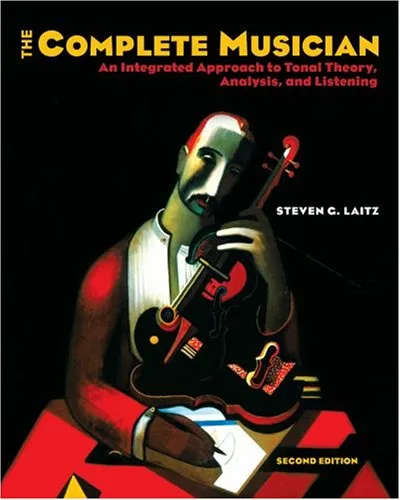
The complete musician: an integrated approach to tonal theory, analysis, and listening
Steven Geoffrey Laitz
2008
View book

Book guide and evaluation
coll.
0 reviews
Published
pages
views
Introduction to "Hearing Harmony: Toward a Tonal Theory for the Rock Era" "Hearing Harmony: Toward a Tonal Theory for the Rock Era" explores the intricate and evolving role of harmony in rock music, a genre that has revolutionized the cultural and musical
Before you read
"Hearing Harmony: Toward a Tonal Theory for the Rock Era" explores the intricate and evolving role of harmony in rock music, a genre that has revolutionized the cultural and musical landscape of the modern era. This book serves as a comprehensive guide for musicians, scholars, and enthusiasts eager to understand how tonal harmony functions within rock music and its departure from the classical tonal system. By bridging theoretical analysis with real-world examples, this work delves deep into the foundations of rock harmony, providing invaluable insights into its structure, logic, and artistic expression.
The book begins with an overview of Western tonal tradition, acknowledging its influence on modern music while pointing out its limitations when applied to the rock era. The author recognizes rock music not as an extension of classical harmony but as a distinct system with its own patterns, principles, and innovations. By doing so, the book challenges conventional frameworks of tonal analysis, advocating for a broader understanding that can fully encapsulate the harmonic language of rock.
A significant portion of the book identifies the unique characteristics of rock harmony and how it differs from classical approaches. From modal interchange and power chord structures to extended guitar voicings and contrapuntal techniques, the book covers a wide array of concepts that define rock's distinct tonal system. The writing simplifies complex theoretical ideas without compromising their depth, ensuring that readers from various backgrounds can follow along.
Furthermore, the book includes numerous real-world examples from classic rock songs, progressive rock anthems, and even contemporary hits. These examples demonstrate how harmonic innovations have evolved within the genre and highlight how rock's tonal system mirrors the genre's spirit of experimentation and rebellion. The book also touches on how technology, such as guitar effects, synthesizers, and recording techniques, has expanded harmonic possibilities within rock music.
"Rock music has its own harmonic DNA, distinct from the classical traditions that often attempt to define it."
"The tonal fabric of rock is woven from a rich interplay of modes, riffs, and textures, each contributing to a tapestry of creative freedom."
"To truly hear harmony in the rock era is to embrace its divergence and celebrate its innovative spirit."
"Hearing Harmony: Toward a Tonal Theory for the Rock Era" fills a critical gap in the fields of musicology and music theory by treating rock music as a legitimate area of scholarly inquiry. While classical tonal theory has served as a strong foundation for understanding Western music, it often proves insufficient for analyzing the harmonic innovations of the rock genre. By offering a dedicated theoretical framework for rock harmony, this book stands as a pivotal resource for music scholars and practitioners alike.
Beyond its theoretical contributions, this book matters because it validates the artistry of rock music—a genre that, despite its cultural significance, is often dismissed in academic circles. It amplifies the voices of legendary rock musicians and composers by treating their work with the depth and respect it deserves. Whether you are a professional musician seeking to expand your understanding of rock harmony or a devoted listener eager to deepen your appreciation of the music, this book will fundamentally alter how you hear and interpret rock music.
Your question is answered in the context of this title and author. Each answer uses 2 points.
0 reviews, 4.0 average out of 5
Sign in to publish a review.
Ask a focused question and learn from the community.
Related references that continue this learning path.
Steven Geoffrey Laitz