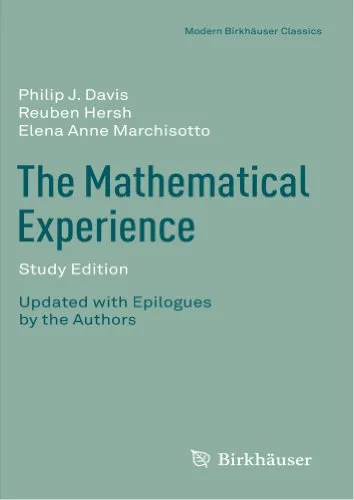
The Mathematical Experience, Study Edition
Philip J. Davis,Reuben Hersh,Elena Anne Marchisotto (auth.)
2012
View book
Book guide and evaluation
Veit Erlmann (editor)
0 reviews
Published
pages
views
Introduction to "Hearing Cultures: Essays on Sound, Listening, and Modernity" "Hearing Cultures: Essays on Sound, Listening, and Modernity," edited by Veit Erlmann, is a groundbreaking interdisciplinary collection of essays exploring the cultural and social significance of
Before you read
"Hearing Cultures: Essays on Sound, Listening, and Modernity," edited by Veit Erlmann, is a groundbreaking interdisciplinary collection of essays exploring the cultural and social significance of sound and hearing in modern societies. This book invites readers to move beyond conventional visual-centric perspectives and delve into the intricate world of auditory culture, where listening and soundscapes profoundly shape our understanding of history, politics, identity, and social interaction. By providing a fresh perspective on the sensory world, this volume addresses the growing interest in auditory studies and the significance of sound in shaping human experiences.
The essays in "Hearing Cultures" critically examine how auditory practices and listening are deeply embedded in societal structures, everyday life, and modernity itself. The book spans various disciplines, including anthropology, sociology, musicology, history, and media studies, creating a rich tapestry of insights into the cultural importance of sound. Each essay brings forward unique perspectives on how human cultures interpret and construct meaning through listening.
Exploring topics ranging from music and language to noise pollution and soundscapes, this book challenges the long-standing dominance of vision in Western epistemology. Readers are introduced to auditory landscapes across different parts of the world, from indigenous communities to urban environments, uncovering how socio-cultural contexts influence auditory experiences. The volume bridges theoretical discussions of sound with real-world examples, including rituals, religious practices, and media technologies, all of which underscore the pivotal role of sound in shaping modernity.
Key contributors, such as Steven Feld, Jonathan Sterne, and other leading scholars, provide thought-provoking analyses rooted in fieldwork, historical research, and theoretical reflection. Collectively, the essays invite us to (re)consider sound not as a mere sensory experience but as a medium through which power, cultural identity, and historical narratives are negotiated.
"The eye sees, but it is the ear that listens and interprets, uncovering meaning in the unspoken and the unnoticed." – Veit Erlmann
"Listening is not merely an act of perception; it is a cultural practice, tied deeply to memory, identity, and power." – Jonathan Sterne
"Auditory culture offers us a way to rethink modernity, not as a visual spectacle but as a soundscape that organizes social life." – Steven Feld
"Hearing Cultures" matters because it addresses a significant gap in cultural and sensory studies by emphasizing the importance of sound and listening in human experience. In a world dominated by visual culture, this book offers much-needed insights into why auditory practices deserve equal attention in understanding society and history. The essays also reveal how technologies like radio, television, and digital media have altered listening practices and contributed to modern transformations.
Additionally, this book contributes to global discussions on soundscapes and noise pollution—pressing issues in urban environments and ecological debates. Recognizing sound as part of cultural heritage, "Hearing Cultures" encourages readers to preserve and celebrate auditory traditions, while also critiquing how certain sounds are marginalized or silenced in the process of modernization.
Whether you're a scholar, a student, or simply someone curious about the ways sound shapes your world, this book opens up new pathways for understanding culture and modernity. It is an indispensable work for anyone interested in the sensory life of human societies.
Your question is answered in the context of this title and author. Each answer uses 2 points.
0 reviews, 4.0 average out of 5
Sign in to publish a review.
Ask a focused question and learn from the community.
Related references that continue this learning path.
Philip J. Davis,Reuben Hersh,Elena Anne Marchisotto (auth.)