Book guide and evaluation
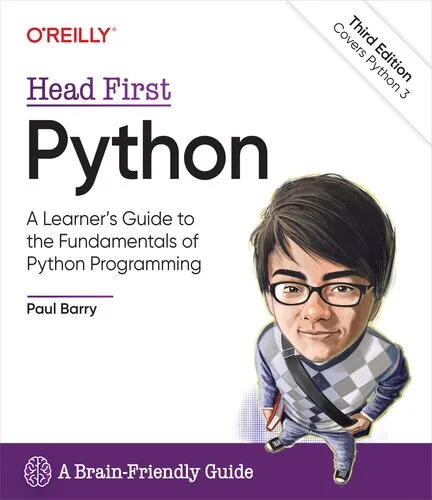
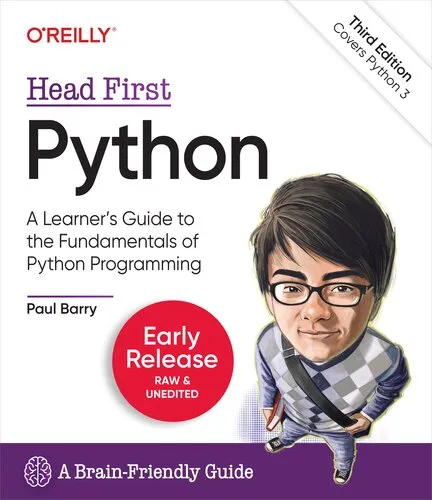
Head First Python: A Learner’s Guide to the Fundamentals of Python Programming, A Brain-Friendly Guide, 3rd Edition (Second Early Release)
Paul Barry
English
Unordered
Programming Languages
4.5 / 5
0 reviews
2023
Published
600
pages
569
views
Want to learn the Python language without slogging your way through how-to manuals? With Head First Python, you'll quickly grasp Python's fundamentals, working with the built-in data structures and functions. Then you'll move on to building your very own webapp, exploring databas
Before you read
What will you get from this book?
Want to learn the Python language without slogging your way through how-to manuals? With Head First Python, you'll quickly grasp Python's fundamentals, working with the built-in data structures and functions. Then you'll move on to building your very own webapp, exploring database management, exception handling, and data wrangling.
If you're intrigued by what you can do with context managers, decorators, comprehensions, and generators, it's all here. This third edition is a complete learning experience that will help you become a bonafide Python programmer in no time.
In order to explore, experiment, and learn about Python, you need to install a runtime back-end called Jupyter into your Python. As you’ll see in a moment, doing so is straightforward. When it comes to creating Python code, you can use just about any programmer’s editor, but we’re recommending you use a specific one when working through this book’s material: Microsoft’s Visual Studio Code, known the world over as VS Code.
Python starts counting from zero, which should sound familiar. In fact, Python has a lot in common with other programming languages. There’s variables, loops, conditionals, functions, and the like. In this, our opening chapter, we take you on a high-level whistle-stop tour of Python’s basics, introducing the language without getting too much into the weeds. You’ll learn how to create and run code within VS Code and Jupyter Notebook. You’ll see how lots of programming functionality comes built-in to Python, which you’ll leverage to get your job done. You’ll also learn that although Python shares a lot of the ideas with other programming languages, how they manifest in your Python code can be, well, different. Now, don’t get the wrong idea here: we’re talking different good, not different bad. Read on to learn more…
Ask this book
Your question is answered in the context of this title and author. Each answer uses 2 points.
Sign in to ask the book assistant.
Reader reviews
0 reviews, 4.5 average out of 5
No reviews yet
If you have read this book, help the next reader with your experience.
Write a review
Sign in to publish a review.
Reader questions and answers
Ask a focused question and learn from the community.
Sign in to ask or answer a question.
No questions yet
Be the first to ask a clear, useful question.
What to read next
Related references that continue this learning path.