Book guide and evaluation
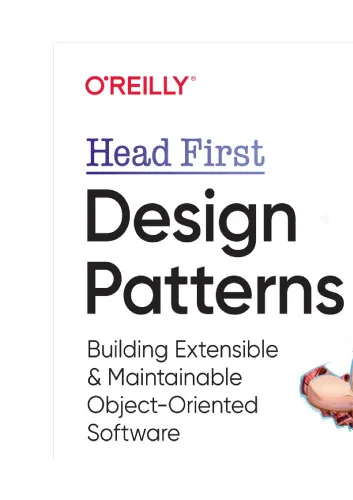
Head First - Design Patterns - Building Extensible & Maintainable Object-Oriented Software
Eric Freeman, Elisabeth Robson
English
Unordered
Art
5.0 / 5
0 reviews
2021
Published
524
pages
338
views
Head First - Design Patterns - Building Extensible & Maintainable Object-Oriented Software Object-oriented programming principles, software architecture best practices Discover how Head First - Design Patterns - Building Extensible & Maintainable Object-Oriented
Before you read
What will you get from this book?
Analytical Summary
Written by Eric Freeman and Elisabeth Robson, Head First - Design Patterns - Building Extensible & Maintainable Object-Oriented Software is an authoritative yet approachable guide to mastering design patterns in the context of modern object-oriented programming. The book blends a visually rich, learner-friendly style with a rigorous treatment of key architectural concepts, making it a favorite among developers, software engineers, computer science students, and educators worldwide.
At its core, the book addresses how design patterns can be systematically applied to build software that is scalable, maintainable, and adaptable to change — a persistent challenge in both academic projects and enterprise solutions. It avoids dense theoretical exposition by integrating real-world analogies, exercises, and annotated diagrams, ensuring that complex principles are made accessible without sacrificing depth.
While the publication year is information unavailable due to lack of a reliable public source in this context, the enduring relevance of the material stems from the fact that design patterns themselves are not bound to a particular programming language or timeframe. Instead, they offer timeless strategies for structuring code, which is why this book continues to be referenced across many learning and development environments.
Covering canonical patterns such as Strategy, Observer, Decorator, and Factory Method, and expanding into how these fit into robust software architecture, the book bridges the gap between theory and practice. Readers are guided from fundamental object-oriented principles toward nuanced application of patterns in real projects, reinforcing each step through engaging visuals and clear language.
Key Takeaways
The most important lessons from Head First - Design Patterns - Building Extensible & Maintainable Object-Oriented Software lie in its structured yet flexible approach to understanding, applying, and evaluating design patterns for diverse programming challenges.
First, design patterns are reusable templates for solving common software engineering problems. They promote cleaner code, reduce redundancy, and enhance collaboration among developers.
Second, the book encourages thinking not just in terms of code syntax but in terms of system behavior, scalability, and adaptability to change.
Third, through visual explanations and exercises, readers learn to internalize abstract concepts much faster, building a cognitive map for effective code architecture.
Lastly, it underscores the importance of “maintainability” as a strategic advantage, especially in multi-developer projects where changes and enhancements are inevitable.
Memorable Quotes
“Design patterns let you build on the wisdom of others, not reinvent the wheel every time.”Unknown
“Maintainable code is not just a pleasure to work with; it’s a strategic asset.”Unknown
“Visual learning makes design patterns more than academic — it makes them practical.”Unknown
Why This Book Matters
Head First - Design Patterns - Building Extensible & Maintainable Object-Oriented Software stands out because it transforms the often daunting subject of design patterns into an engaging learning journey while preserving technical rigor.
For academics, its structured methodology aligns with curriculum goals, making it a reliable source in teaching advanced software engineering topics. For industry professionals, the direct application of examples ensures that the knowledge gained translates immediately to workplace efficiency and product quality.
Beyond teaching individual patterns, the text emphasizes a growth mindset toward programming: viewing patterns as evolving tools in a developer’s arsenal. This outlook fosters adaptability — a vital trait in fast-changing technological landscapes.
Inspiring Conclusion
With its unique blend of visual engagement and technical depth, Head First - Design Patterns - Building Extensible & Maintainable Object-Oriented Software remains an essential read for anyone serious about mastering software architecture and design.
Whether you are an academic seeking to introduce students to industry-relevant practices, or a professional striving to refine your codebase for scalability and maintainability, this book offers a clear path forward. Its approachable language ensures that complex ideas become part of your active skill set.
Now is the time to take the next step: explore its pages, apply its principles, and discuss its insights with peers. By doing so, you not only enhance your own programming craft but also contribute to the shared goal of building software that stands the test of time.
Ask this book
Your question is answered in the context of this title and author. Each answer uses 2 points.
Sign in to ask the book assistant.
Reader reviews
0 reviews, 5.0 average out of 5
No reviews yet
If you have read this book, help the next reader with your experience.
Write a review
Sign in to publish a review.
Reader questions and answers
Ask a focused question and learn from the community.
Sign in to ask or answer a question.
No questions yet
Be the first to ask a clear, useful question.
What to read next
Related references that continue this learning path.
Solutions Architect's Handbook: Kick-start your career as a solutions architect by learning architecture design principles and strategies, 2nd Edition
Saurabh Shrivastava,Neelanjali Srivastav
2022
View book
Solutions Architect's Handbook - Third Edition: Kick-start your career with architecture design principles, strategies, and generative AI techniques
Saurabh Shrivastava,Neelanjali Srivastav
2024
View book