
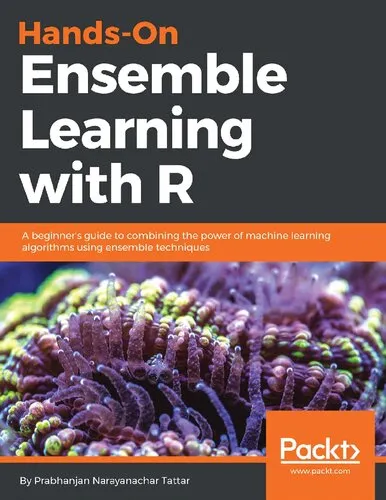
Hands-On Ensemble Learning with R: A beginner's guide to combining the power of machine learning algorithms using ensemble techniques
Prabhanjan Narayanachar Tattar
2018
View book
Book guide and evaluation
Garrett Grolemund
0 reviews
Published
pages
views
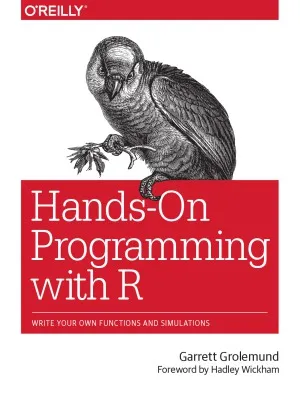
Hands-On Programming with R R programming fundamentals, data analysis with R Hands-On Programming with R teaches practical coding and data skills for analysts, researchers, and R enthusiasts. Analytical Summary Hands-On Programming with R is a meticulous guide cra
Before you read
Hands-On Programming with R is a meticulous guide crafted to lead readers from beginner-level exposure to a confident, functional mastery of the R programming language. Written by Garrett Grolemund, this resource delivers a rare blend of practical exercises and conceptual clarity, offering an immediate bridge between abstract programming theory and its real-world applications in data analysis, statistical modeling, and reproducible research.
The book begins with an accessible introduction to R’s syntax and structure, allowing even those unfamiliar with coding to quickly grasp the essentials. As the chapters advance, readers encounter a progression of projects that incrementally deepen their understanding—spanning character manipulation, vector operations, control structures, and function writing. Grolemund’s approach emphasizes coding “by doing,” ensuring that theoretical knowledge is cemented through hands-on experimentation.
In addition to its instructional flow, Hands-On Programming with R is steeped in real-world relevance. Readers learn to import, clean, and visualize data, moving beyond rote code snippets to a mindset where problems are solved systematically. Whether intended for analytics professionals, academics, or students, this guide offers a framework that can be directly transferred to research, industry projects, or collaborative environments where data integrity and reproducibility are key.
At its core, Hands-On Programming with R delivers enduring competencies that extend far beyond the book’s pages, forming the foundation for advanced analytics and programming work.
First, readers learn that writing functions in R is not merely a technical exercise—it is a path toward creating efficient, maintainable, and reusable code. This is coupled with an emphasis on problem decomposition, a principle that strengthens one’s capacity to tackle complex projects.
Second, the book instills the habit of approaching data analytically: from importing raw datasets to shaping them through transformation functions, readers develop fluency in wrangling data structures to suit analytical goals.
Third, Grolemund promotes the importance of reproducibility. This concept ensures that analytical insights are verifiable and that workflows can be shared transparently with peers or collaborators, aligning with best practices in both academic and professional domains.
Finally, the text cultivates an intuitive grasp of R, making future learning—whether about specialized libraries or advanced statistical techniques—considerably more approachable.
Programming isn’t about typing—it’s about thinking. Unknown
Code that you understand today will guide you through problems tomorrow. Unknown
Learning R is best done not by reading alone, but by building something real. Unknown
Hands-On Programming with R stands apart for its project-based methodology, its seamless integration of coding fundamentals, and its service to multiple audiences.
In academic circles, mastering R through practical application ensures that statistical findings are reproducible and auditable, strengthening the credibility of research. In industry, professionals appreciate the efficiency gained from writing purposeful, organized code tailored to complex data sets.
Furthermore, Grolemund’s clear instructional style lowers the barrier for individuals transitioning from other languages or statistical tools into R. The depth of exercises encourages learners to rethink their approach to problem-solving, making this guide an indispensable tool in the era of data-driven decision-making.
Publication year information is unavailable due to no reliable public source confirming it within official bibliographic records at this time.
Hands-On Programming with R is more than a book—it is an invitation to engage deeply with data, code, and the art of analytical thinking.
By guiding readers through tangible coding experiences, it transforms abstract concepts into actionable skills. Whether you are an academic aiming to enhance reproducible research, a professional seeking to scale data solutions, or a curious learner exploring statistical programming, this guide’s structured yet flexible approach ensures a rewarding journey.
Now is the moment to explore Hands-On Programming with R firsthand—read it, share it with peers, and discuss the insights it sparks. Your future work with data will be stronger, clearer, and grounded in well-crafted, maintainable code.
Your question is answered in the context of this title and author. Each answer uses 2 points.
0 reviews, 4.5 average out of 5
Sign in to publish a review.
Ask a focused question and learn from the community.
Related references that continue this learning path.
Prabhanjan Narayanachar Tattar
Thomas Mailund (auth.)