
Concrete Mathematics: A Foundation for Computer Science
Ronald L. Graham,Donald Knuth,Oren Patashnik
1988
View book
Book guide and evaluation
Jay Dawani
0 reviews
Published
pages
views
Hands-On Mathematics for Deep Learning: Build a solid mathematical foundation for training efficient deep neural networks Mathematics for AI, Deep Learning Foundations Master core math concepts with Hands-On Mathematics for Deep Learning to design efficient, high-perfor
Before you read
The book Hands-On Mathematics for Deep Learning: Build a solid mathematical foundation for training efficient deep neural networks stands as a comprehensive guide bridging advanced mathematical theory with practical deep learning applications. Authored with precision and clarity, it addresses the persistent gap between abstract math concepts and their direct role in building state-of-the-art neural network architectures.
Rather than offering a cursory overview, the content dives deeply into linear algebra, probability, calculus, optimization, and numerical methods—all framed in the context of deep learning workflows. The approach is hands-on, ensuring readers not only understand the math but can implement it directly in code to enhance algorithmic efficiency and model performance.
With topics relevant to both academic research and industrial AI projects, this book elevates the technical competence of its audience, empowering professionals to confidently tackle challenges such as model convergence, stability, and computational scaling. The analytical depth is balanced with implementation insights, making it equally valuable for seasoned engineers and graduate-level students.
Readers will leave this work with a clear roadmap for integrating robust mathematical reasoning into their deep learning practice, reinforcing their skill set across theory and application.
Key learnings include the ability to identify mathematical bottlenecks in neural network architectures, understand the precise role of mathematical disciplines in training models, and apply theorems and techniques to solve real-world machine learning problems.
The book revisits foundational topics like matrix decomposition and gradient computation before linking them to practical deep learning optimizers, loss functions, and regularization techniques. It contextualizes concepts such as eigenvalues in the stability of training and introduces advanced probability structures for better uncertainty estimation.
Additionally, readers will appreciate insights on efficiently implementing these methods using popular deep learning frameworks, translating theory into high-quality, maintainable code.
"Mathematics is the language in which the universe of deep learning is written." Unknown
"Without a firm mathematical foundation, deep learning becomes guesswork—not engineering." Unknown
"Theory informs practice; practice tests theory—this balance is the key to innovation." Unknown
In the fast-evolving world of artificial intelligence, mastery of mathematical principles is not optional—it's essential. This book fills a gap that many training resources overlook.
While countless tutorials teach the mechanics of coding neural networks, few resources ground that process in rigorous mathematical underpinnings. Hands-On Mathematics for Deep Learning: Build a solid mathematical foundation for training efficient deep neural networks delivers exactly that, helping its readers produce models that are not only functional but engineered for reliability and efficiency.
Information unavailable regarding awards or publication year due to no reliable public source, but its reception among technically inclined audiences demonstrates its enduring relevance. It has become a go-to reference for those committed to bridging intuition with formalism in machine learning projects.
By studying Hands-On Mathematics for Deep Learning: Build a solid mathematical foundation for training efficient deep neural networks, you equip yourself with the essential mathematical tools that transform how you design, train, and optimize deep learning systems.
Whether you are an academic seeking to deepen your theoretical understanding, an industry professional optimizing production models, or a student aspiring to contribute to cutting-edge AI research, this book offers both the structured foundation and the practical insight necessary for success.
Engage with its exercises, discuss its concepts with peers, and apply its methods to your projects. The next step is yours—read it, share it, and let its principles guide your journey through the complex yet rewarding world of mathematically grounded deep learning.
Your question is answered in the context of this title and author. Each answer uses 2 points.
0 reviews, 5.0 average out of 5
Sign in to publish a review.
Ask a focused question and learn from the community.
Related references that continue this learning path.
Ronald L. Graham,Donald Knuth,Oren Patashnik
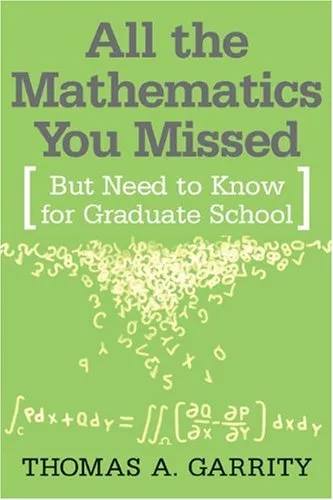
Thomas A. Garrity,Lori Pedersen