Loading
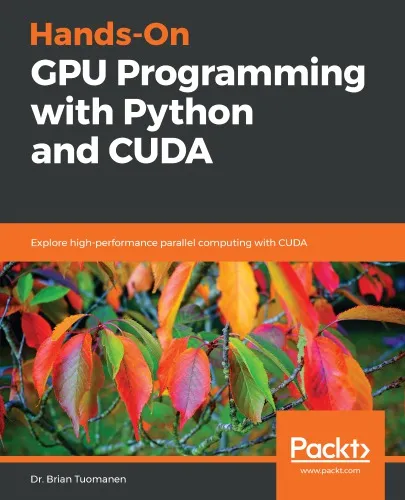
Cover of Hands-On GPU Programming with Python and CUDA: Explore high-performance parallel computing with CUDA

Book guide and evaluation

Hands-On GPU Programming with Python and CUDA: Explore high-performance parallel computing with CUDA

Dr. Brian Tuomanen

English Advanced Data Science
5.0 / 5

1 reviews

2018

Published

310

pages

556

views

Hands-On GPU Programming with Python and CUDA hits the ground running: you'll start by learning how to apply Amdahl's Law, use a code profiler to identify bottlenecks in your Python code, and set up an appropriate GPU programming environment. You'll then see how to “query” the GP

Before you read

What will you get from this book?

Hands-On GPU Programming with Python and CUDA hits the ground running: you'll start by learning how to apply Amdahl's Law, use a code profiler to identify bottlenecks in your Python code, and set up an appropriate GPU programming environment. You'll then see how to “query” the GPU's features and copy arrays of data to and from the GPU's own memory. As you make your way through the book, you'll launch code directly onto the GPU and write full blown GPU kernels and device functions in CUDA C. You'll get to grips with profiling GPU code effectively and fully test and debug your code using Nsight IDE. Next, you'll explore some of the more well-known NVIDIA libraries, such as cuFFT and cuBLAS. With a solid background in place, you will now apply your new-found knowledge to develop your very own GPU-based deep neural network from scratch. You'll then explore advanced topics, such as warp shuffling, dynamic parallelism, and PTX assembly. In the final chapter, you'll see some topics and applications related to GPU programming that you may wish to pursue, including AI, graphics, and blockchain. By the end of this book, you will be able to apply GPU programming to problems related to data science and high-performance computing. What you will learn Launch GPU code directly from Python Write effective and efficient GPU kernels and device functions Use libraries such as cuFFT, cuBLAS, and cuSolver Debug and profile your code with Nsight and Visual Profiler Apply GPU programming to datascience problems Build a GPU-based deep neuralnetwork from scratch Explore advanced GPU hardware features, such as warp shuffling Who this book is for Hands-On GPU Programming with Python and CUDA is for developers and data scientists who want to learn the basics of effective GPU programming to improve performance using Python code. You should have an understanding of first-year college or university-level engineering mathematics and physics, and have some experience with Python as well as in any C-based programming language such as C, C++, Go, or Java.

Ask this book

Your question is answered in the context of this title and author. Each answer uses 2 points.

Sign in to ask the book assistant.

Reader reviews

1 reviews, 5.0 average out of 5

Nandan Vatsyayan

2025/06/07

5 / 5

I followed the guides in the book and adapted the codes from the book in my own kernel which is running correctly now. The author was recommending that Python 2 is more stable than 3, which is very true -- with 3, I got many strange nvcc errors, even for the sample codes of the book when only a blank space or a blank line was added. I would recommend the book anyone who needs to save their time.
Write a review

Sign in to publish a review.

Reader questions and answers

Ask a focused question and learn from the community.

Sign in to ask or answer a question.

No questions yet

Be the first to ask a clear, useful question.