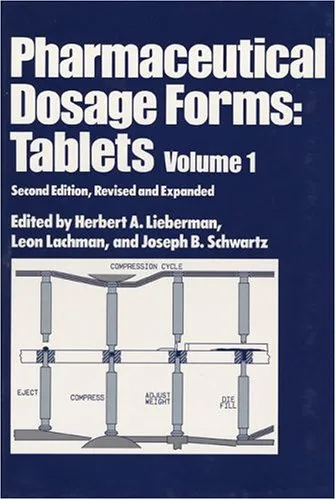
Pharmaceutical Dosage Forms: Tablets, Vol. 1
Herbert Lieberman,Leon Lachman,Joseph B. Schwartz
1989
View book

Book guide and evaluation
Ajit S. Narang,Sherif I.F. Badawy
0 reviews
Published
pages
views
Introduction to the "Handbook of Pharmaceutical Wet Granulation: Theory and Practice in a Quality by Design Paradigm" The pharmaceutical industry is a cornerstone of modern healthcare, constantly striving to develop innovative methods to efficiently manufacture high-qualit
Before you read
The pharmaceutical industry is a cornerstone of modern healthcare, constantly striving to develop innovative methods to efficiently manufacture high-quality therapeutic products. Among the critical processes in tablet and capsule production is wet granulation, which has served as a mainstay technique for decades due to its ability to improve drug uniformity, flowability, and compressibility. "Handbook of Pharmaceutical Wet Granulation: Theory and Practice in a Quality by Design Paradigm" delves deep into the intricate world of wet granulation, offering a rich amalgamation of theoretical perspectives and practical approaches for researchers, formulation scientists, and production specialists.
Authored by Ajit S. Narang and Sherif I.F. Badawy, this comprehensive text serves as a guiding light for both novices and experienced professionals, contextualizing wet granulation within the modern principles of Quality by Design (QbD). The book meticulously explores the science, engineering, and quality aspects of wet granulation, while emphasizing regulatory compliance and risk-based manufacturing design. By integrating cutting-edge technologies and the latest advancements in pharmaceutical manufacturing, the authors craft a structured roadmap for readers looking to optimize process efficiency and product performance.
The "Handbook of Pharmaceutical Wet Granulation" is an in-depth treatise designed to address every facet of wet granulation within the paradigm of Quality by Design. Comprising contributions from industry experts and researchers, the book methodically examines the foundational principles of granulation science, different types of granulation technologies, and their relevance to achieving predefined product quality. It provides practical solutions for common manufacturing challenges, including issues with granule size distribution, moisture content control, and binder effectiveness.
Beginning with the history and basics of wet granulation, the book seamlessly transitions into granular mechanics, binder interactions, and the role of excipients. It also discusses high-shear, fluidized bed, and twin-screw granulation technologies, ensuring the content is accessible to professionals employing various methodologies. The final sections of the book not only delve into scale-up considerations but also explore the impact of digitalization, such as process analytical technologies (PAT), and the role of computational modeling in wet granulation design.
"Granulation is not just an art form—it is a scientific endeavor that bridges the gap between therapeutic value and manufacturability."
"Every granule tells a story of formulation design, process optimization, and patient needs."
The "Handbook of Pharmaceutical Wet Granulation" is more than just a technical reference; it is a comprehensive guide that aligns pharmaceutical manufacturing practices with modern regulatory expectations. With an increasing emphasis on Quality by Design, the pharmaceutical industry needs a resource that not only explains the underlying science but also defines a systematic approach to process development. This book bridges that knowledge gap by offering practical solutions anchored in real-world applications.
Moreover, digital transformation in the pharmaceutical industry is reshaping how processes are designed, analyzed, and controlled. The integration of advanced tools and technologies like computational modeling and PAT into wet granulation has enormous implications for manufacturers looking to enhance efficiency and compliance. This book places particular focus on these advancements, empowering readers to stay competitive in an evolving landscape.
Whether you are a researcher delving into the intricacies of excipient interactions, a process engineer scaling up manufacturing operations, or a regulatory specialist ensuring compliance, this resource is invaluable. Its structured framework ensures readers can translate theory into practice, driving innovation and maintaining the highest standards of quality.
Your question is answered in the context of this title and author. Each answer uses 2 points.
0 reviews, 4.0 average out of 5
Sign in to publish a review.
Ask a focused question and learn from the community.
Related references that continue this learning path.
Herbert Lieberman,Leon Lachman,Joseph B. Schwartz
Larry, L.A.andLieberman, H.andSchwartz, J.B.
Lena Ohannesian,Anthony Streeter