
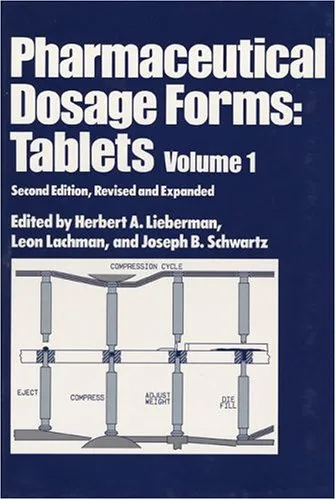
Pharmaceutical Dosage Forms: Tablets, Vol. 1
Herbert Lieberman,Leon Lachman,Joseph B. Schwartz
1989
View book
Book guide and evaluation
Sarfaraz Niazi
0 reviews
Published
pages
views
Introduction to the Handbook of Pharmaceutical Manufacturing Formulations - Liquid Products (Volume 3 of 6) The pharmaceutical industry thrives on precision, innovation, and regulation. As one of the most dynamic fields, it demands meticulous formulation developmen
Before you read
The pharmaceutical industry thrives on precision, innovation, and regulation. As one of the most dynamic fields, it demands meticulous formulation development for every product. Among the vast categories of pharmaceutical formulations, liquid products hold a vital position due to their versatile applications: from injectable solutions to oral syrups and topical formulations.
“Handbook of Pharmaceutical Manufacturing Formulations – Liquid Products (Volume 3 of 6)” has been crafted as a comprehensive guide harmonizing science, technology, and regulatory requirements for pharmaceutical professionals, researchers, and students. This volume provides a detailed roadmap for the industrial-scale manufacturing of liquid products, offering practical insights into formulations while addressing critical aspects like compliance, stability, and scale-up challenges.
This book is part of a six-volume series aimed at providing an authoritative foundation in pharmaceutical manufacturing for virtually all dosage forms. Volume 3 focuses exclusively on liquid products, pulling together years of expertise, field-tested methods, and deep regulatory insights to make this handbook an indispensable reference for the pharmaceutical industry.
The Handbook of Pharmaceutical Manufacturing Formulations – Liquid Products dives into the intricate process of manufacturing liquid dosage formulations. This volume spans a diverse range of liquid formulations, including oral suspensions, solutions, emulsions, syrups, eye drops, nasal sprays, and parenteral solutions. Each product category is rigorously detailed, covering ingredients, manufacturing processes, quality standards, and regulatory constraints.
The book places strong emphasis on addressing real-world challenges encountered in scaling up production, meeting stability expectations, and adhering to global regulatory frameworks. Moreover, it incorporates a balanced blend of theoretical insights and practical examples, ensuring that readers can effectively bridge the gap between conceptual formulation development and actual manufacturing practices.
The content extends to cover sophisticated formulations, including sterile manufacturing, lyophilization, and solubilization methods for poorly water-soluble drugs. This, coupled with an exploration of excipient compatibility and product stability, makes this book a practical guide for both beginners and experienced professionals aiming to master liquid pharmaceutical manufacturing.
"The science of liquid formulations integrates simplicity and complexity—simplicity as the form may look homogeneous, but complexity in stabilizing molecules in a state suitable for therapeutic success."
"In pharmaceutical manufacturing, success is in the details. The smallest oversight in a liquid formulation could lead to system-wide failure, a costly mistake the industry cannot afford."
"Formulating medicines is not just about science; it is the ethical commitment to deliver safe and effective care to millions worldwide."
In an industry where precision is paramount, ‘Handbook of Pharmaceutical Manufacturing Formulations – Liquid Products’ emerges as a cornerstone resource. This book demystifies the manufacturing of liquid formulations by dissecting it into accessible and actionable steps. Whether you are tasked with developing a stable syrup for pediatric use or producing sterile injectables for hospitals, this volume serves as an invaluable guide.
The book matters because it doesn’t just focus on “how to make” formulations but also emphasizes the “why” behind every decision made in the formulation and manufacturing process. From understanding excipient functionality to complying with strict regulatory demands, every page of this book is steeped in practical wisdom designed to ensure quality, safety, and efficacy.
Additionally, this handbook provides clarity in times of rapid technological change and evolving regulations. Liquid formulations, being one of the most widely used dosage forms, come with inherent challenges like microbial contamination and chemical degradation. By thoroughly addressing these issues alongside methods to mitigate them, this book proves itself as a critical companion for navigating these challenges successfully.
In conclusion, Volume 3 – Liquid Products is not just a technical manual but a benchmark resource catering to the multifaceted needs of the pharmaceutical manufacturing community. Its adaptability, depth, and relevance make it an enduring contribution to the literature in pharmaceutical sciences.
Your question is answered in the context of this title and author. Each answer uses 2 points.
0 reviews, 4.0 average out of 5
Sign in to publish a review.
Ask a focused question and learn from the community.
Related references that continue this learning path.
Herbert Lieberman,Leon Lachman,Joseph B. Schwartz
Larry, L.A.andLieberman, H.andSchwartz, J.B.
John F. Marriott,Keith A Wilson,Ph.d.,Christopher Andrew Langley,Dawn Belcher