
Book guide and evaluation
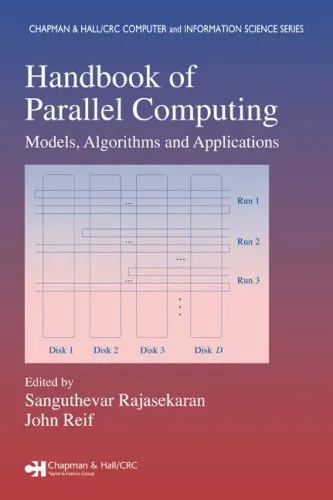
Handbook of parallel computing: models, algorithms and applications
Sanguthevar Rajasekaran,John Reif
English
Beginner
Data Structures
4.0 / 5
0 reviews
2007
Published
1172
pages
427
views
Introduction to the "Handbook of Parallel Computing: Models, Algorithms, and Applications" The "Handbook of Parallel Computing: Models, Algorithms, and Applications" is an authoritative and comprehensive resource designed to provide researchers, computer scientists, and de
Before you read
What will you get from this book?
Introduction to the "Handbook of Parallel Computing: Models, Algorithms, and Applications"
The "Handbook of Parallel Computing: Models, Algorithms, and Applications" is an authoritative and comprehensive resource designed to provide researchers, computer scientists, and developers with a deep understanding of parallel computing. Co-authored by experts Sanguthevar Rajasekaran and John Reif, this book serves as an invaluable reference for those eager to explore both foundational concepts and cutting-edge advancements in parallel and distributed computing. With the constant evolution of technology, understanding parallel computation has become integral to solving complex problems more efficiently, making this handbook a crucial guide for the 21st century.
Detailed Summary of the Book
This handbook delves into parallel computing from three perspectives: theoretical foundations, algorithmic design, and practical applications. It aims to equip readers with the necessary tools to tackle challenges associated with multicore processors, distributed systems, and advanced computation models. The book begins by exploring fundamental concepts in parallel computing, such as computational models and architectures, before swiftly transitioning to highly specialized topics, including graph algorithms, matrix computations, and optimization techniques.
The editors present a balanced combination of theory and practice, blending formal models with real-world implementations. Each chapter, written by subject-matter experts, addresses a specific aspect of parallelism. Notable topics covered in the book include shared memory, distributed memory, data-parallel programming languages, and applications in areas like bioinformatics, cryptography, and machine learning. This ensures that readers from both academia and industry can find substantial value, whether they are conducting research or designing efficient, scalable systems.
Key Takeaways
The "Handbook of Parallel Computing" offers a wealth of knowledge on various aspects of parallelism and distributed systems. Some of the most prominent takeaways include:
- A clear breakdown of parallel architectures, from multicore CPUs to GPU computing and cloud systems.
- A variety of algorithms optimized for different kinds of parallel computation and memory architectures.
- Insights into scheduling, load balancing, and fault-tolerant techniques, critical for developing robust systems.
- Applications of parallel computing across various domains, including scientific simulations, financial modeling, and artificial intelligence.
- Discussions on emerging technological trends, such as quantum computing and big data frameworks.
Famous Quotes from the Book
"Parallel computing is not simply faster computing—it is smarter computing. It is the art of solving larger problems by using smarter techniques on multiple cores or distributed systems."
"The rise of multicore and many-core systems has redefined the fidelity of computation, making efficient parallel algorithms no longer a luxury but a necessity."
Why This Book Matters
Parallel computing has become a cornerstone of modern computation in industries and research domains that demand speed, scalability, and efficiency. The "Handbook of Parallel Computing: Models, Algorithms, and Applications" addresses the growing need for expertise and prepares readers to harness the power of multi-threaded and distributed systems effectively. As technological advancements in areas like artificial intelligence, data science, and scientific simulations continue to accelerate, parallelism lies at the heart of solving resource-intensive computational problems.
What truly sets this book apart is its interdisciplinary nature. It offers engineers and software professionals practical guidance on creating scalable applications, while researchers benefit from its detailed theoretical foundations. The broad coverage of topics ensures that it remains relevant across multiple domains, from biology and cryptography to emerging paradigms like quantum computing and neural networks. In essence, this handbook stands as a bridge between foundational computer science principles and real-world problem-solving approaches. It is a must-read for anyone looking to make a meaningful contribution to computational sciences.
Ask this book
Your question is answered in the context of this title and author. Each answer uses 2 points.
Sign in to ask the book assistant.
Reader reviews
0 reviews, 4.0 average out of 5
No reviews yet
If you have read this book, help the next reader with your experience.
Write a review
Sign in to publish a review.
Reader questions and answers
Ask a focused question and learn from the community.
Sign in to ask or answer a question.
No questions yet
Be the first to ask a clear, useful question.
What to read next
Related references that continue this learning path.
Algorithms and Theory of Computation Handbook
Richard E. Klima,Neil Sigmon,Ernest Stitzinger
1998
View book