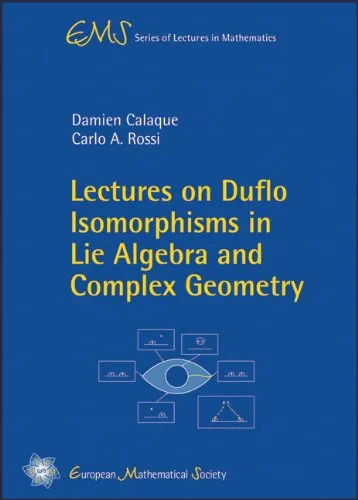
Lectures on Duflo Isomorphisms in Lie Algebra and Complex Geometry (EMS Series of Lectures in Mathematics)
Damien Calaque,Carlo A. Rossi
2011
View book
Book guide and evaluation
Andrei D. Polyanin,Valentin F. Zaitsev
0 reviews
Published
pages
views
Introduction to the Handbook of Ordinary Differential Equations The "Handbook of Ordinary Differential Equations: Exact Solutions, Methods, and Problems" by Andrei D. Polyanin and Valentin F. Zaitsev is an indispensable resource for mathematicians, scientists, and engineers. T
Before you read
The "Handbook of Ordinary Differential Equations: Exact Solutions, Methods, and Problems" by Andrei D. Polyanin and Valentin F. Zaitsev is an indispensable resource for mathematicians, scientists, and engineers. This comprehensive text explores ordinary differential equations (ODEs) and provides a wealth of exact solutions, analytical methods, and practical problems in a carefully structured and richly detailed format. This handbook has been meticulously crafted to serve both as a reference guide for experienced professionals and as an educational tool for students and researchers delving into the world of differential equations.
Ordinary differential equations permeate every area of science, technology, and engineering. From describing natural phenomena to modeling engineering systems, ODEs are a cornerstone of mathematical formulation and interpretation. This book boldly tackles the depth and breadth of ODEs and is highly praised for its organized and systematic presentation. With over 3,000 exact solutions to various types of ODEs, the handbook serves as a reliable reference for solving practical and theoretical problems alike.
This handbook is designed to cover a vast range of topics, including linear and nonlinear equations, equations with constant and variable coefficients, systems of ODEs, and special functions. For each type of ODE, analytical methods of solution are discussed in detail, ensuring clarity for readers. Additionally, the authors provide relevant applications across physics, mechanics, biology, and other fields. The easy-to-navigate structure of the book makes it accessible for readers at all levels, whether they are practicing professionals or emerging scholars.
The carefully curated problems add value by providing readers with opportunities to test their understanding of ODE theory and solution methods. The inclusion of modern computational approaches works in harmony with the classical methods to give the book a forward-thinking edge. This dual approach ensures the text remains relevant in today's rapidly evolving scientific and technological landscape.
The "Handbook of Ordinary Differential Equations" stands out as a timeless work due to its combination of comprehensiveness and practical utility. Here are some key takeaways from this book:
Here are a few notable excerpts from the text that underscore its depth and practical utility:
"Differential equations lie at the foundation of mathematical modeling and provide a window into understanding physical realities."
"The exact solutions contained in this book serve as benchmarks, guiding researchers toward accurate and efficient numerical and analytical methods."
"Finding solutions to ordinary differential equations is not just a mathematical exercise but a pursuit that touches on the very fabric of science and technology."
The "Handbook of Ordinary Differential Equations" holds a unique place in the literature of mathematics due to its unwavering focus on precision, depth, and practicality. For researchers and educators, it serves as a crucial tool for crafting new scientific inquiries and developing teaching curricula. For engineers and scientists in the field, the wealth of exact solutions and analytical methods provides actionable tools for solving real-world challenges.
The book's scientific rigor ensures that professionals and students alike can rely on it as a bridge between theory and application. At its core, it exemplifies how mathematics can serve as a universal language to describe the dynamics and complexities of the natural world. By bridging classical and modern methods, the text remains timeless while staying current with emerging trends.
In a world where mathematics continues to grow in importance across disciplines, this handbook ensures that foundational toolsets like ODEs are accessible, understandable, and practically useful. As such, it not only enriches knowledge but also empowers its readers to approach challenges with confidence and clarity.
Your question is answered in the context of this title and author. Each answer uses 2 points.
0 reviews, 4.5 average out of 5
Sign in to publish a review.
Ask a focused question and learn from the community.
Related references that continue this learning path.
Damien Calaque,Carlo A. Rossi