

Handbook for Brunner and Suddarth's Textbook of Medical-Surgical Nursing, 12th Edition
Suzanne C. Smeltzer
2009
View book
Book guide and evaluation
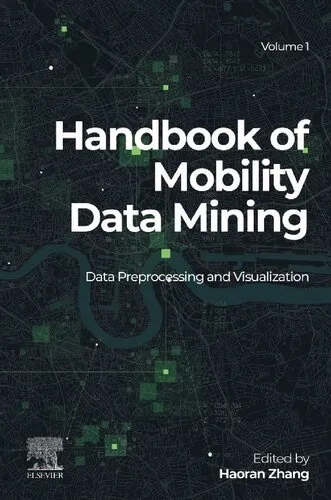
Haoran Zhang
0 reviews
Published
pages
views
Introduction to "Handbook of Mobility Data Mining, Volume 1: Data Preprocessing and Visualization" The dramatic evolution of mobility services, urban infrastructure, and smart technologies has led to an avalanche of data — mobility data that holds immense potential for res
Before you read
The dramatic evolution of mobility services, urban infrastructure, and smart technologies has led to an avalanche of data — mobility data that holds immense potential for reshaping how we understand, design, and manage transportation systems. "Handbook of Mobility Data Mining, Volume 1: Data Preprocessing and Visualization" serves as a comprehensive guide to navigating this growing field, focusing specifically on the essential aspects of data preprocessing and visualization techniques. Whether you're new to mobility data or a seasoned expert in data science, this book equips readers with tools, techniques, and insights to turn raw mobility data into actionable intelligence.
The book opens with a contextual overview of mobility data mining, emphasizing the importance of extracting meaningful insights from the complex, high-dimensional, and often noisy data generated by modern-day transportation systems. From traffic flow sensors and GPS data to ride-sharing apps and public transit systems, mobility data mining provides a fresh lens to analyze how people and goods move through urban and rural spaces.
At the heart of this volume lies two critical components of the data-driven workflow: preprocessing and visualization. Data preprocessing is explored extensively — from understanding the intricacies of mobility datasets to cleaning, normalizing, and transforming raw data into usable formats. Techniques such as handling missing data, noise reduction, temporal alignment, and feature engineering are described in detail, highlighting real-world scenarios from diverse urban environments.
Visualization, the second cornerstone of this book, acknowledges the necessity of creating intuitive, informative, and aesthetically compelling tools to interpret data. The book dives into using visualization frameworks, map-based tools (e.g., heatmaps, flow diagrams), and time-series visualizations to uncover hidden trends. By combining technical rigor with practical examples, the book ensures the readers develop not just theoretical knowledge, but also the ability to apply concepts in practice.
With numerous examples, case studies, and problem-solving approaches, this volume sets the stage for professional growth in mobility data mining, equipping individuals with actionable skills essential for research, public policy, and industry projects.
"Mobility data mining isn’t about simply collecting information; it's about transforming the way we understand movement, connection, and the flow of our urban lives."
"Without rigorous preprocessing, even the most sophisticated algorithms will fail to uncover truths from noise. Preprocessing is the undisputed foundation of all data-driven insights."
"Visualization transforms raw numbers into narratives. A good visualization doesn’t just show; it reveals, persuades, and informs."
Mobility data mining is no longer a niche field — it is a cornerstone of modern transportation planning, urban development, and technological innovation. As the volume, velocity, and variety of mobility data sources continue to grow, there is an urgent need for data scientists, engineers, and policymakers to effectively preprocess and visualize data to solve critical challenges such as traffic congestion, carbon emissions, and accessibility.
This book fills a vital gap in the literature by focusing on the most challenging yet overlooked components of mobility data workflows: preprocessing and visualization. Through its structured approach, it empowers readers to construct efficient and accurate data pipelines, ultimately enabling better decisions for smarter cities and sustainable transportation systems. By bridging technical depth with approachable writing, this book ensures accessibility to a broad audience, from academia to industry practitioners.
Whether you are working in urban planning, transportation management, data science, or beyond, "Handbook of Mobility Data Mining, Volume 1" is an indispensable resource for unlocking the power of mobility data.
Your question is answered in the context of this title and author. Each answer uses 2 points.
0 reviews, 4.0 average out of 5
Sign in to publish a review.
Ask a focused question and learn from the community.
Related references that continue this learning path.
Suzanne C. Smeltzer

Prachi Manoj Joshi,Parikshit Narendra Mahalle