

Lectures on Duflo Isomorphisms in Lie Algebra and Complex Geometry (EMS Series of Lectures in Mathematics)
Damien Calaque,Carlo A. Rossi
2011
View book
Book guide and evaluation
Rutwig Campoamor-Stursberg,Michel Rausch de Traubenberg
0 reviews
Published
pages
views
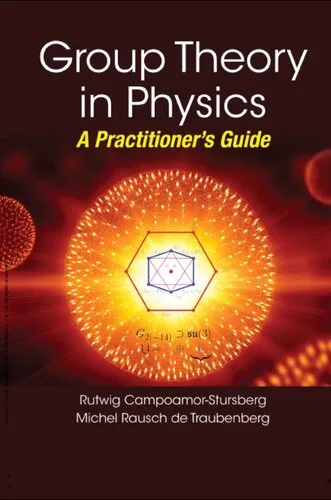
Introduction to "Group Theory in Physics: A Practitioner's Guide" Physics, at its very foundation, relies on symmetry and structure to describe the intricate workings of the universe. Mathematical group theory lies at the heart of this framework, providing elegant
Before you read
Physics, at its very foundation, relies on symmetry and structure to describe the intricate workings of the universe. Mathematical group theory lies at the heart of this framework, providing elegant and powerful tools to explain everything from quantum mechanics to crystallography and particle physics. The book "Group Theory in Physics: A Practitioner's Guide" serves as a comprehensive companion for physicists and students alike, offering a meticulously crafted roadmap to understanding this fascinating intersection of abstract algebra and physical phenomena.
Authored by distinguished experts in mathematics and physics, this book bridges the gap between theory and application, presenting group theory not as a strictly mathematical abstraction but as a practical, problem-solving framework tailored for physicists. Through clear, intuitive explanations and real-world examples, the book empowers readers to harness group theory's power across numerous disciplines, providing a resource that is as intellectually enriching as it is technically indispensable.
This book is designed to demystify group theory and make it accessible to physicists and other scientific practitioners seeking deeper insights into symmetry and invariance principles. Starting with the fundamentals, the book builds a solid foundation in group theory, covering core concepts such as groups, representations, Lie algebras, and symmetry transformations. Through careful progression, it moves from elementary representations of finite groups to more advanced subjects like continuous Lie groups, their algebras, and the central role they play in the Standard Model of particle physics.
The later sections of the book focus on specific applications in physics, exploring topics such as symmetries in quantum mechanics, crystallography, and field theory. Unlike many traditional treatments, "Group Theory in Physics: A Practitioner's Guide" emphasizes practical methodologies that scientists can immediately apply to problems in their own research areas. The clarity of its formula derivations and physical interpretations make this book invaluable not only for theoretical physicists but also for experimentalists looking to decode the symmetry principles underlying physical systems.
Novices will find an accessible learning trajectory with plenty of examples, while more seasoned practitioners will appreciate the book's detailed treatment of advanced topics. By combining rigor with readability, this guide serves as a lifelong reference for physicists who aim to master group theory and unlock its full potential in their careers.
"Group Theory in Physics: A Practitioner's Guide" matters because it addresses a critical gap in the scientific literature: the need for a clear, practical, and physics-oriented treatment of group theory. While many resources tend to focus on purely mathematical aspects, this book uniquely integrates deep theoretical insights with real-world applications. It is a book for everyone, from aspiring graduate students seeking a better grasp of mathematical physics to seasoned researchers who wish to refine their understanding of group-related phenomena.
In an age where interdisciplinary research is flourishing, the topics covered in this book hold immense relevance. Whether you are tackling symmetry breaking in quantum field theory, designing materials with specific crystal structures, or simply searching for a unified framework to organize physical laws, the tools provided by group theory are indispensable. This book ensures that scientists are well-equipped to work at the cutting edge of research in multiple domains. Moreover, its clear presentation makes it a pleasure to read, blending rigor with accessibility.
In summary, this book is not just a guide; it is a gateway to understanding the profound structures underlying our universe. It matters because it empowers scientists to think in terms of symmetry, unleashing the full potential of group theory to advance knowledge and innovation.
Your question is answered in the context of this title and author. Each answer uses 2 points.
0 reviews, 4.5 average out of 5
Sign in to publish a review.
Ask a focused question and learn from the community.
Related references that continue this learning path.
Damien Calaque,Carlo A. Rossi

Anton Betten,Axel Kohnert,Reinhard Laue,Alfred Wassermann


Toyokazu Hiramatsu,Seiken Saito