
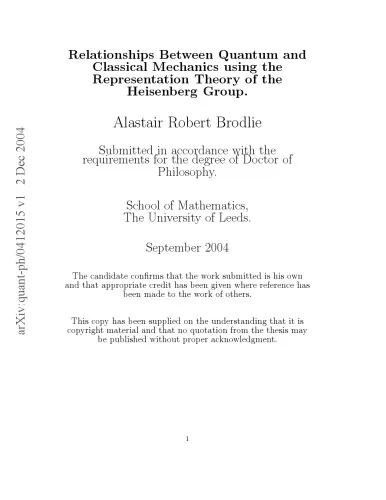
Relationships between quantum and classical mechanics using the representation theory of the Heisenberg group
Alastair Robert Brodlie;University of Leeds
2004
View book
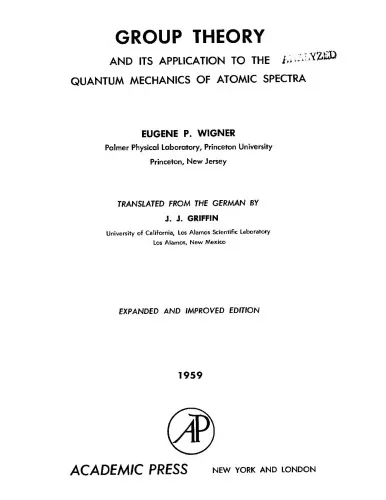
Book guide and evaluation
E. Wigner
0 reviews
Published
pages
views
Welcome to an in-depth examination of Group Theory and its Application to the Quantum Mechanics of Atomic Spectra (expanded), a seminal work that bridges profound mathematical theories with the complex realities of quantum mechanics. This expanded edition further explores the
Before you read
Welcome to an in-depth examination of Group Theory and its Application to the Quantum Mechanics of Atomic Spectra (expanded), a seminal work that bridges profound mathematical theories with the complex realities of quantum mechanics. This expanded edition further explores the symmetries and group structures that are foundational to understanding atomic spectra, making it an invaluable resource for physicists, mathematicians, and scholars alike.
In Group Theory and its Application to the Quantum Mechanics of Atomic Spectra, we delve into the intricate connections between group theory and the quantum mechanics governing atomic spectra. This book systematically unveils the algebraic structures at play, elucidating how group theory provides tools for analyzing symmetry in quantum systems. The expanded edition includes enriched content that explores newly discovered relationships and applications, offering deeper insights into atomic and molecular physics.
The book begins with a foundational review of group theory principles, setting the stage for more advanced topics such as representation theory, Lie groups, and character theory. Subsequent chapters meticulously connect these mathematical constructs with the principles of quantum mechanics, focusing on the atomic spectra, perturbation theory, and selection rules. By demystifying these concepts, the text presents a clear pathway to understanding how mathematical symmetries facilitate quantum mechanical predictions and interpretations.
"Mathematics not only provides a framework for physical theories but acts as a guiding beacon illuminating paths to deeper understanding."
"In the realm of atomic interactions, symmetry is not just a geometric notion; it is a fundamental principle that orchestrates the behavior of nature."
This book holds a pivotal place in the literature of both mathematical and physical sciences. It addresses the profound need for a comprehensive understanding of how group theory can be employed to solve complex physical problems, particularly those encountered in the study of atomic structures. The interdisciplinary approach enhances the reader's capacity to tackle fundamental and advanced topics in physics through the lens of mathematical elegance and precision.
Beyond its immediate application to physics, this work serves as a testament to the power of mathematical abstraction in unraveling the secrets of the universe. It bridges gaps between theoretical ideas and practical applications, thereby reinforcing the unity of knowledge across disciplines. With an expanded content that reflects the latest scientific advancements, this book is more relevant than ever for students, educators, and researchers striving to understand the inner workings of atomic spectra.
Your question is answered in the context of this title and author. Each answer uses 2 points.
0 reviews, 4.7 average out of 5
Sign in to publish a review.
Ask a focused question and learn from the community.
Related references that continue this learning path.
Alastair Robert Brodlie;University of Leeds
EUGENE P. WIGNER (Eds.)
Henry EhrenreichandFrans Spaepen (Eds.)