

Book guide and evaluation
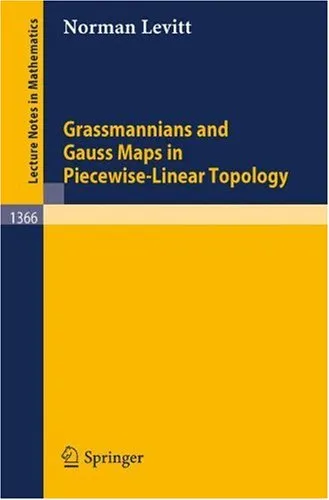
Grassmannians and Gauss Maps in Piecewise-Linear and Piecewise-Differential Topology
Norman Levitt
English
Beginner
Mathematics
4.4 / 5
0 reviews
1989
Published
207
pages
231
views
Welcome to the intricate and fascinating world of "Grassmannians and Gauss Maps in Piecewise-Linear and Piecewise-Differential Topology". This book delves deep into the sophisticated mathematical concepts that define the interaction between Grassmannians, a pivotal area struc
Before you read
What will you get from this book?
Welcome to the intricate and fascinating world of "Grassmannians and Gauss Maps in Piecewise-Linear and Piecewise-Differential Topology". This book delves deep into the sophisticated mathematical concepts that define the interaction between Grassmannians, a pivotal area structure in geometry, and Gauss maps, which are crucial in understanding curvature and mappings within piecewise-linear and piecewise-differential topological structures. With this book, you'll explore the convergence of theories, practical applications, and the unifying elements of geometry and topology, presented with clarity and insight.
Detailed Summary
The book embarks on a journey through the mathematical landscapes shaped by Hermann Grassmann and Carl Friedrich Gauss’s profound contributions. Grassmannians serve as the backbone of this narrative, offering a comprehensive analysis of vectors and linear algebra’s core principles. The text opens avenues to piecewise-linear (PL) topology, providing a roadmap for understanding complex geometrical spaces constructed from simplexes, and navigating differential topology, which extends these ideas into smooth structures.
Central to the volume is the concept of Gauss maps, which translate geometric information across dimensional boundaries. These maps are intricately examined through their representation in both PL and piecewise-differential (PD) topology, offering insights into curvature theory and its adaptations in discrete models. The book succeeds in creating a robust framework to explain how these theories extend from pure mathematics into applied contexts, touching on significant applications in areas like computer graphics, complex system modeling, and high-dimensional data analysis.
Key Takeaways
- Understanding the structure of Grassmannians and their role within various topological and geometric paradigms.
- In-depth analysis of Gauss maps and their applications in describing curvature and mappings in both discrete and continuous domains.
- The convergence of pure mathematical theory with practical applications in technology and scientific computation.
- Exploration of piecewise-linear and piecewise-differential topology's relevance in modern scientific inquiry.
Famous Quotes from the Book
"In the interplay of Grassmannians and Gauss maps, lies the key to a deeper understanding not just of geometry, but of the very fabric of spatial reasoning itself."
"Topology, whether smooth or linear, provides a language through which the abstract and the real conjoin to offer a tapestry of insight and innovation."
Why This Book Matters
The importance of "Grassmannians and Gauss Maps in Piecewise-Linear and Piecewise-Differential Topology" cannot be overstated. As our scientific world becomes ever more driven by data and complex systems, the mathematical frameworks that allow us to analyze and interpret multivariate structures grow in necessity and impact. This book shines a light on foundational concepts that are pivotal in the progression of fields ranging from theoretical physics to computer science.
By comprehensively covering the intricate dance between algebra, topology, and geometry, Norman Levitt's work serves as an invaluable resource for mathematicians and scientists alike. It equips readers with tools to not only engage with these subjects at a theoretical level but also apply them in real-world scenarios, thereby bridging the gap between theory and practice.
Ultimately, this book is more than a mere exposition of mathematical ideas. It is a celebration of the power of abstract thought and its indispensable role in solving concrete problems. For anyone poised at the precipice of mathematical exploration, this book is both a guide and an inspiration.
Ask this book
Your question is answered in the context of this title and author. Each answer uses 2 points.
Sign in to ask the book assistant.
Reader reviews
0 reviews, 4.4 average out of 5
No reviews yet
If you have read this book, help the next reader with your experience.
Write a review
Sign in to publish a review.
Reader questions and answers
Ask a focused question and learn from the community.
Sign in to ask or answer a question.
No questions yet
Be the first to ask a clear, useful question.
What to read next
Related references that continue this learning path.


Modern Computer Vision with PyTorch: A Practical Roadmap From Deep Learning Fundamentals to Advanced Applications and Generative AI, 2nd Edition
V Kishore Ayyadevara,Yeshwanth Reddy
2023
View book