
Book guide and evaluation
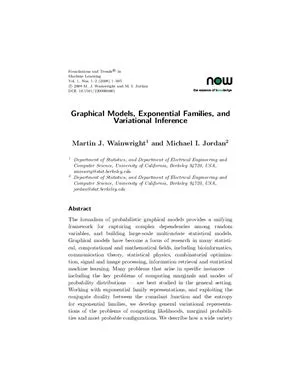
Graphical Models, Exponential Families, and Variational Inference
Wainwright M.J. Jordan M.I.
English
Beginner
Machine Learning
4.4 / 5
0 reviews
-
Published
305
pages
289
views
Из серии Foundations and Trends in Machine Learning издательства NOWPress, 2008, -305 pp.The formalism of probabilistic graphical models provides a unifying framework for capturing complex dependencies among random variables, and building large-scale multivariate statistical mode
Before you read
What will you get from this book?
Из серии Foundations and Trends in Machine Learning издательства NOWPress, 2008, -305 pp.The formalism of probabilistic graphical models provides a unifying framework for capturing complex dependencies among random variables, and building large-scale multivariate statistical models. Graphical models have become a focus of research in many statistical, computational and mathematical fields, including bioinformatics, communication theory, statistical physics, combinatorial optimization, signal and image processing, information retrieval and statistical machine learning. Many problems that arise in specific instances — including the key problems of computing marginals and modes of probability distributions — are best studied in the general setting. Working with exponential family representations, and exploiting the conjugate duality between the cumulant function and the entropy for exponential families, we develop general variational representations of the problems of computing likelihoods, marginal probabilities and most probable configurations. We describe how a wide variety of algorithms — among them sum-product, cluster variational methods, expectation-propagation, mean field methods, max-product and linear programming relaxation, as well as conic programming relaxations — can all be understood in terms of exact or approximate forms of these variational representations. The variational approach provides a complementary alternative to Markov chain Monte Carlo as a general source of approximation methods for inference in large-scale statistical models.IntroductionBackgroundGraphical Models as Exponential FamiliesSum-Product, Bethe–Kikuchi, and Expectation-PropagationMean Field MethodsVariational Methods in Parameter EstimationConvex Relaxations and Upper BoundsInteger Programming, Max-product, and Linear Programming RelaxationsMoment Matrices, Semidefinite Constraints, and Conic Programming RelaxationDiscussionA Background MaterialB Proofs and Auxiliary Results: Exponential Families and DualityC Variational Principles for Multivariate GaussiansD Clustering and Augmented HypergraphsE Miscellaneous Results
Ask this book
Your question is answered in the context of this title and author. Each answer uses 2 points.
Sign in to ask the book assistant.
Reader reviews
0 reviews, 4.4 average out of 5
No reviews yet
If you have read this book, help the next reader with your experience.
Write a review
Sign in to publish a review.
Reader questions and answers
Ask a focused question and learn from the community.
Sign in to ask or answer a question.
No questions yet
Be the first to ask a clear, useful question.
What to read next
Related references that continue this learning path.
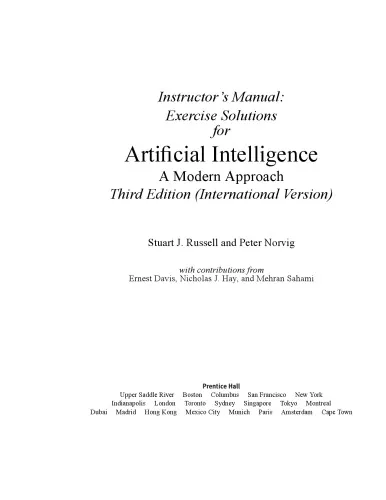
Instructor’s Manual: Exercise Solutions for Artificial Intelligence A Modern Approach - Third Edition
Stuart J. RussellandPeter Norvig
2010
View book
Distributed Artificial Intelligence: A Modern Approach
Satya Prakash Yadav (editor),Dharmendra Prasad Mahato (editor),Nguyen Thi Dieu Linh (editor)
2021
View book