Book guide and evaluation
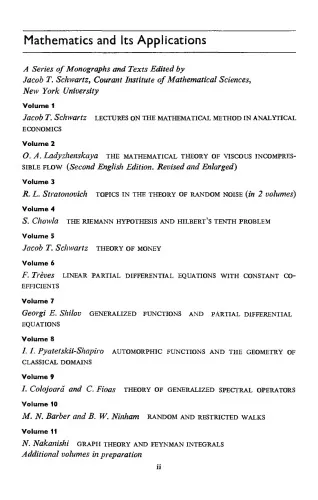
Graph Theory and Feynman Integrals (Mathematics and Its Applications)
N. Nakanishi
English
Beginner
Graph Theory
4.5 / 5
0 reviews
1971
Published
232
pages
536
views
Welcome to Graph Theory and Feynman Integrals, a comprehensive guide that seamlessly blends the intriguing domains of graph theory and Feynman integrals. This book resides within the larger framework of mathematics, specifically as part of the series "Mathematics and Its Appl
Before you read
What will you get from this book?
Welcome to Graph Theory and Feynman Integrals, a comprehensive guide that seamlessly blends the intriguing domains of graph theory and Feynman integrals. This book resides within the larger framework of mathematics, specifically as part of the series "Mathematics and Its Applications". Its goal is to serve as an invaluable resource for mathematicians, physicists, and researchers aiming to deepen their understanding of the relationship between these two pivotal areas of study.
Detailed Summary of the Book
At the core of this book lies the intricate connection between graphs and Feynman diagrams, which are instrumental in physics, especially in quantum field theory. Beginning with the basics of graph theory, the book introduces essential concepts such as vertices, edges, and graph cycles. It then progresses towards more advanced topics like connectivity, graph coloring, and planar graphs, offering readers a firm grounding in theoretical underpinnings.
The second portion delves into Feynman integrals, starting from their origin in representing particle interactions within quantum field theory. The book meticulously explores how these integrals arise from Feynman diagrams, providing a step-by-step approach to their computation and the physical insights they offer. By integrating complex analysis, topology, and algebra, the book deciphers the multi-layered process of evaluating Feynman integrals.
Through a systematic exposition, the book elucidates how graph theory acts as a vital abstraction for understanding the structure and evaluation of Feynman integrals. Packed with examples, mathematical proofs, and illustrative diagrams, the text empowers readers to navigate the challenging yet rewarding paths to mastering these advanced topics.
Key Takeaways
- Discover the foundational principles of graph theory and their application to physical sciences.
- Gain a clear understanding of Feynman diagrams and the integrals that arise from them in the context of quantum field theory.
- Learn to employ mathematical tools from complex analysis, topology, and algebra to tackle intricate problems involving Feynman integrals.
- Enhance problem-solving skills through rigorous mathematical proofs and practical examples.
- Develop an appreciation for the complex interplay between abstract mathematical theories and their real-world applications in physics.
Famous Quotes from the Book
"In the elegant language of graphs, one uncovers the profound symmetries and intricate dance of particles as nature's most subtle whispers become visible."
"The beauty of Feynman integrals lies not merely in their computational challenge but in the illumination they provide upon the lattice of the universe."
Why This Book Matters
This book stands as a significant scholarly resource because it bridges a critical gap in the literature concerning the interaction of mathematics and physics. In an era where interdisciplinary knowledge spearheads scientific progress, understanding the symbiotic relationship between graph theory and Feynman integrals is more essential than ever.
With clarity and depth, the text provides readers with methodological insights and analytical techniques that are crucial for advancing in fields like theoretical and mathematical physics, computer science, and engineering. Whether utilized for academic study or professional development, this book prepares its readers not merely to understand, but to innovate and explore new horizons.
Ultimately, Graph Theory and Feynman Integrals (Mathematics and Its Applications) invites you on a journey to uncover the astonishing unity between mathematical abstraction and physical reality, facilitating groundbreaking contributions to science and technology.
Ask this book
Your question is answered in the context of this title and author. Each answer uses 2 points.
Sign in to ask the book assistant.
Reader reviews
0 reviews, 4.5 average out of 5
No reviews yet
If you have read this book, help the next reader with your experience.
Write a review
Sign in to publish a review.
Reader questions and answers
Ask a focused question and learn from the community.
Sign in to ask or answer a question.
No questions yet
Be the first to ask a clear, useful question.
What to read next
Related references that continue this learning path.