Book guide and evaluation
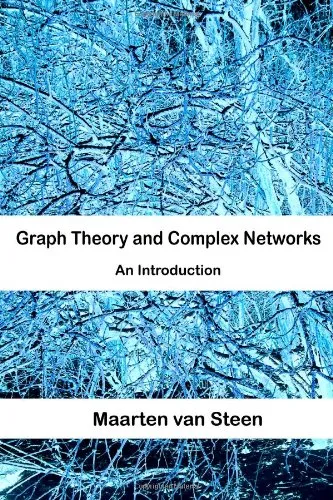
Graph Theory and Complex Networks: An Introduction
Maarten van Steen
English
Beginner
Mathematic Combinatorics
4.5 / 5
0 reviews
2010
Published
299
pages
609
views
Introduction to Graph Theory and Complex Networks: An Introduction Embark on a captivating journey into the world of graphs and the intricate networks they form, with "Graph Theory and Complex Networks: An Introduction." This book serves as a gateway into the d
Before you read
What will you get from this book?
Introduction to Graph Theory and Complex Networks: An Introduction
Embark on a captivating journey into the world of graphs and the intricate networks they form, with "Graph Theory and Complex Networks: An Introduction." This book serves as a gateway into the dense yet exhilarating exploration of structures that underpin much of today's technological and natural world.
Detailed Summary of the Book
The book delves into the foundational concepts of graph theory, simplifying complex mathematical formulations into accessible explanations. Through its chapters, readers are introduced to the essential types of graphs, including directed and undirected graphs, weighted and unweighted graphs, as well as more intricate concepts such as trees, bipartite graphs, and planar graphs.
As you progress, the narrative widens to encompass the realm of complex networks. Here, the book seamlessly transitions into the examination of real-world phenomena such as social networks, biological networks, and technological networks. This transition highlights how graph theory's abstraction can accurately model and analyze network dynamics critical to understanding connectivity, flow, and behavior within diverse systems.
The synergy between theoretical knowledge and practical application is a cornerstone of this text. Through comprehensive examples and problem sets, readers can strengthen their grasp of algorithmic techniques and network processes, empowering them to analyze and derive insights from complex data networks. These exercises, paired with intuitive explanations, make the learning process both rigorous and rewarding.
Key Takeaways
- Fundamental concepts of graph theory and their applications in real-world networks.
- Understanding the mechanics of various network models and their relevance to contemporary problems.
- Ability to apply graph algorithms to practical challenges, facilitating data-driven decisions.
- Insight into the interconnectedness and complexity of various types of networks, from social to biological.
Famous Quotes from the Book
"Graph theory provides a lens through which the complex interconnections within systems are not only understood but anticipated and navigated."
"In the abstractness of a graph lies the universality of networks that connect everything, from neurons in a brain to computers across the globe."
Why This Book Matters
In an era where connectivity defines progress and understanding, "Graph Theory and Complex Networks: An Introduction" emerges as an essential tool for scholars, professionals, and enthusiasts alike. As networks grow in complexity, the insights drawn from graph theory become increasingly pivotal for innovation and strategy across industries.
The profound impact of networks on sectors such as communications, healthcare, and technology makes mastering their underlying principles not just beneficial but imperative. This book equips readers with the knowledge and skills to decipher these structures, enabling them to harness networked systems' full potential.
Moreover, as data continues to proliferate, the methods elucidated in this book offer a means to be not only reactive but proactive in managing and interpreting vast networks. As such, this text occupies a crucial role in the educational landscape, reflecting the growing need for network literacy in a digitally dependent world.
Ask this book
Your question is answered in the context of this title and author. Each answer uses 2 points.
Sign in to ask the book assistant.
Reader reviews
0 reviews, 4.5 average out of 5
No reviews yet
If you have read this book, help the next reader with your experience.
Write a review
Sign in to publish a review.
Reader questions and answers
Ask a focused question and learn from the community.
Sign in to ask or answer a question.
No questions yet
Be the first to ask a clear, useful question.
What to read next
Related references that continue this learning path.