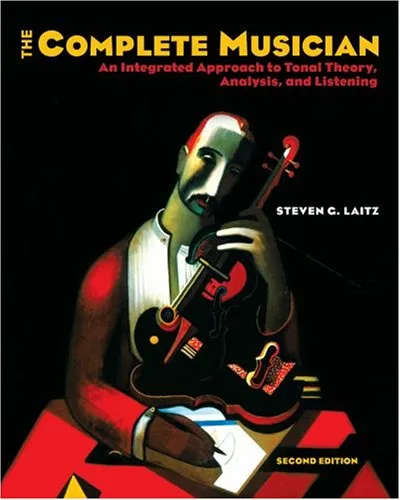
The complete musician: an integrated approach to tonal theory, analysis, and listening
Steven Geoffrey Laitz
2008
View book

Book guide and evaluation
Steven G Laitz,Christopher Bartlette
0 reviews
Published
pages
views
Introduction to "Graduate Review of Tonal Theory: A Recasting of Common-Practice Harmony, Form, and Counterpoint" "Graduate Review of Tonal Theory: A Recasting of Common-Practice Harmony, Form, and Counterpoint" by Steven G. Laitz and Christopher Bartlette is a comprehensi
Before you read
"Graduate Review of Tonal Theory: A Recasting of Common-Practice Harmony, Form, and Counterpoint" by Steven G. Laitz and Christopher Bartlette is a comprehensive and modern exploration of tonal theory designed for advanced students of music. This book challenges conventional approaches to music theory, offering innovative perspectives on harmony, counterpoint, and musical form within the framework of Common-Practice Period music. Whether you're a graduate student preparing for exams or a professional musician seeking to deepen your understanding of tonal music, this text serves as a critical resource for mastering the theory and structure of tonal music across disciplines.
Written by two respected educators in the field of music theory, the book not only revisits traditional theoretical concepts but also reframes them in a way that highlights their relevance to contemporary pedagogy and performance practice. By integrating a fresh analytical lens and emphasizing flexibility in interpretation, the authors facilitate a deeper engagement with the historical and theoretical underpinnings of music that has shaped Western art over centuries.
This text provides a systematic and thorough review of tonal theory, spanning topics such as diatonic and chromatic harmony, contrapuntal techniques, and musical forms found in works from the Baroque, Classical, and Romantic periods. The book begins by revisiting foundational concepts like intervals, scales, and triads, ensuring students have a solid grasp of the basics before delving into more advanced topics.
A significant portion of the book is dedicated to exploring harmony, with chapters that dissect secondary dominants, modulation, chromaticism, and enharmonic reinterpretation. The authors give special attention to voice-leading logic and the rules of counterpoint, offering clear explanations and contextual examples to reinforce comprehension. Additionally, the study of form—such as binary, ternary, sonata, and rondo forms—is presented not merely as a structural framework, but as a means of understanding musical narrative and expression.
The inclusion of numerous exercises and examples makes the book both theoretical and practical. Students are encouraged to actively analyze scores, compose in stylistic idioms, and critically reflect on how theory can inform performance and interpretation. This balance of analysis, composition, and performance ensures that the book speaks to a wide audience, whether they are theorists, composers, or performers.
"Theory is more than an abstract set of rules; it is a way of uncovering the creative logic behind musical works that have endured for centuries."
"Through an understanding of tonal theory, musicians gain insights not only into the structure of music but also into its expressive potential and interpretive possibilities."
"Harmony and counterpoint are not opposing forces; they are two sides of the same coin, working together to shape the dynamic flow of music."
"Graduate Review of Tonal Theory" stands out as an essential resource in the field of music education for its ability to engage with the complexities of tonal music in an accessible and meaningful way. By rethinking traditional approaches to pedagogy, the authors ensure that students and educators alike can develop a nuanced understanding of theory without being constrained by rigid methodologies.
The book’s incorporation of historical and contextual insights allows readers to explore connections between theoretical principles and compositional practices, fostering a richer appreciation for the artistry of tonal music. Additionally, its targeted approach to graduate-level coursework makes it a trusted guide for students navigating the challenging terrains of comprehensive exams and higher-level music theory.
In summary, "Graduate Review of Tonal Theory" bridges the gap between historical scholarship and modern music-making, equipping its readers with the tools they need to analyze, compose, and perform with confidence. Its blend of rigorous analysis, practical application, and creative thinking ensures that it remains a cornerstone of music theory education for years to come.
Your question is answered in the context of this title and author. Each answer uses 2 points.
0 reviews, 4.7 average out of 5
Sign in to publish a review.
Ask a focused question and learn from the community.
Related references that continue this learning path.
Steven Geoffrey Laitz

Bruce Fraser,Jeff Schewe