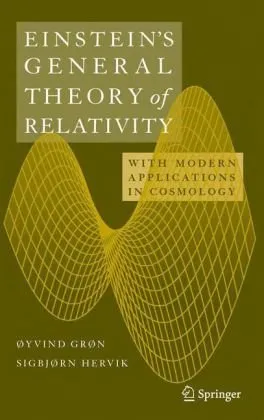
Einstein's general theory of relativity: with modern applications in cosmology
Øyvind Grøn,Sigbjorn Hervik
2007
View book
Book guide and evaluation
Rodney D. Holder
0 reviews
Published
pages
views
Introduction to "God, the Multiverse, and Everything: Modern Cosmology and the Argument from Design" In an age when science continues to push the boundaries of our understanding of the universe, the relationship between cosmology and theology has grown increasing
Before you read
In an age when science continues to push the boundaries of our understanding of the universe, the relationship between cosmology and theology has grown increasingly complex and fascinating. "God, the Multiverse, and Everything: Modern Cosmology and the Argument from Design" brings this dialogue into sharp focus, engaging with some of the most profound questions about existence, meaning, and the cosmos. Written to resonate with both intellectually curious lay readers and scholars, this book offers a deep exploration of the fine-tuning of the universe and what it might mean for the existence of a divine creator.
At its core, this book examines the intersection of modern cosmology, which studies the origins and structure of the universe, and the age-old teleological argument, which asserts that the purpose and order seen in the universe point to a designer. It tackles urgent and fascinating topics surrounding the multiverse theory, fine-tuning, and the ultimate philosophical implications of these scientific theories. By delving into this terrain, the book encourages readers to think critically about the nature of the universe and whether its intricacies demand a metaphysical explanation.
The book begins by laying the groundwork with an accessible introduction to modern cosmology and the history of fine-tuning arguments. It examines the physical constants and parameters of the universe which appear extraordinarily delicate, such that even slight variations in their values would prevent the formation of stars, planets, or life itself.
The later chapters dive into the multiverse hypothesis, a concept that posits the existence of a potentially infinite number of universes, each with different physical laws or constants. Critics argue that the multiverse removes the "need" for God to explain the fine-tuning of our universe, while proponents of design respond that even a multiverse might necessitate a designer. The book methodically evaluates these opposing viewpoints with rigor and precision.
The narrative also revisits classical and contemporary teleological arguments while weaving in perspectives from philosophy, metaphysics, and theology. Key questions such as "Does cosmological fine-tuning require a designer?" and "What are the implications of the multiverse theory for the existence of God?" are explored. Additionally, the book grapples with the philosophical limitations of science in addressing ultimate questions and probes the relationship between faith and reason.
"The universe we inhabit is not merely a brute fact of existence, but a finely-tuned mechanism that invites us to consider the profound possibility of purpose and design."
"To truly grapple with the implications of modern cosmology is to confront timeless questions about why we are here – questions that science alone cannot fully answer."
"God, the Multiverse, and Everything" fills an important niche in the ongoing dialogue between science and religion. At a time when discussions about the multiverse and fine-tuning dominate much of modern scientific discourse, this book raises critical questions about the philosophical and theological implications of these concepts.
It acknowledges both the marvels of scientific discovery and the limits of empirical inquiry. By doing so, it bridges the gap between two traditionally divided domains—science and theology—inviting readers to engage with both disciplines in their quest for understanding. This book is essential reading for those interested in ultimate questions about existence, regardless of whether one approaches the topic from a scientific, philosophical, or theological perspective.
Ultimately, the book reaffirms the value of wonder and curiosity, reminding us that the search for answers about the universe is a shared human endeavor. By presenting a balanced and thought-provoking examination, Rodney D. Holder contributes meaningfully to one of humanity’s oldest and most significant conversations.
Your question is answered in the context of this title and author. Each answer uses 2 points.
0 reviews, 4.5 average out of 5
Sign in to publish a review.
Ask a focused question and learn from the community.
Related references that continue this learning path.
Øyvind Grøn,Sigbjorn Hervik
Jeffrey O. Bennett,Megan Donahue,Nicholas O Schneider,Mark Voit