
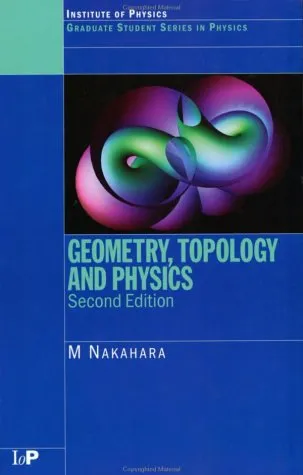
Book guide and evaluation
Geometry, topology, and physics
Mikio Nakahara
English
Beginner
Mathematics
4.6 / 5
0 reviews
2003
Published
583
pages
532
views
Introduction "Geometry, Topology, and Physics" is a crucial text that bridges the illustrious realms of mathematics and theoretical physics. Written by esteemed scholar Mikio Nakahara, this book masterfully integrates fundamental concepts of geometry and topology with the
Before you read
What will you get from this book?
Introduction
"Geometry, Topology, and Physics" is a crucial text that bridges the illustrious realms of mathematics and theoretical physics. Written by esteemed scholar Mikio Nakahara, this book masterfully integrates fundamental concepts of geometry and topology with the complex theories of physics, providing an indispensable resource for students, educators, and researchers alike. The evolved understanding from this text allows readers to gain new insights into the methodologies employed within high-energy physics, string theory, and beyond. This introduction will navigate through the detailed aspects of the book, highlighting its significance and offering an array of key takeaways and renowned quotes.
Detailed Summary of the Book
The book begins with foundational chapters that introduce differential geometry and topology, which are the mathematical backbone of modern theoretical physics. These concepts are indispensable for those delving into general relativity and various quantum field theories. Nakahara presents these subjects with clarity, using both rigorous mathematical formulations and intuitive explanations.
As the narrative progresses, the book explores a vast array of applications of geometry and topology in physics, ranging from fiber bundles and gauge theories to applications in supersymmetry and string theory. The text includes essential topics like homotopy, homology, and Chern-Simons theory, making it a comprehensive guide. Each chapter is enriched with examples and exercises that bolsters the reader's understanding, leading to a more profound grasp on how these mathematical tools can be applied to solve real-world physics problems.
The final sections of the book delve into more advanced topics, offering insights into recent developments in quantum physics. The integration of detailed proofs, extensive appendices, and a glossary of terms ensures that the text serves not only as a learning resource but also as a reference for ongoing research.
Key Takeaways
Readers of "Geometry, Topology, and Physics" find themselves equipped with a solid understanding of the mathematical structures essential for modern physics. Some key takeaways include:
- Deepened awareness of differential geometry and its physical implications.
- Insights into the role of topology in formulating quantum field theories.
- Application of fiber bundles and gauge theories within high-energy physics.
- An understanding of the connections between geometry, topology, and string theory.
- Enhanced problem-solving skills via carefully structured exercises and examples.
Famous Quotes from the Book
“The mathematics involved may be sophisticated, but one must always bear in mind the physical insight it provides.”
“Topology without geometry is a shapeless landscape, much like physics without mathematics is devoid of precision.”
Why This Book Matters
"Geometry, Topology, and Physics" remains a pivotal text because it effectively demystifies the complex interplay between mathematics and physics, making it accessible to those engaged in scientific research as well as dedicated students entering these fields. Its relevance persists as theoretical physics continues to be a driving force in the pursuit of understanding the universe at its most fundamental level.
The book serves as a bridge for physicists who need to utilize advanced mathematics for their work, allowing for the unification of theoretical developments and practical applications. Furthermore, as new frontiers in science require even greater integration, the insights drawn from Nakahara’s work are indispensable for aspiring scholars and seasoned professionals alike.
Ask this book
Your question is answered in the context of this title and author. Each answer uses 2 points.
Sign in to ask the book assistant.
Reader reviews
0 reviews, 4.6 average out of 5
No reviews yet
If you have read this book, help the next reader with your experience.
Write a review
Sign in to publish a review.
Reader questions and answers
Ask a focused question and learn from the community.
Sign in to ask or answer a question.
No questions yet
Be the first to ask a clear, useful question.
What to read next
Related references that continue this learning path.

Finite Fields and Applications: 7th International Conference, Fq7, Toulouse, France, May 5-9, 2003. Revised Papers
Wilfried Meidl,Arne Winterhof (auth.),Gary L. Mullen,Alain Poli,Henning Stichtenoth (eds.)
2004
View book
Software for Algebraic Geometry (The IMA Volumes in Mathematics and its Applications, 148)
Michael E. Stillman (editor),Nobuki Takayama (editor),Jan Verschelde (editor)
2008
View book