

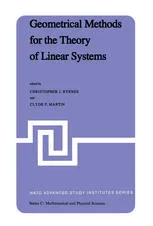
Book guide and evaluation
Geometrical Methods for the Theory of Linear Systems: Proceedings of a NATO Advanced Study Institute and AMS Summer Seminar in Applied Mathematics held at Harvard University, Cambridge, Mass., June 18–29, 1979
C. Byrnes,M. Hazewinkel,C. Martin (auth.),Christopher I. Byrnes,Clyde F. Martin (eds.)
English
Beginner
Mathematics
4.7 / 5
0 reviews
1980
Published
319
pages
126
views
Introduction to "Geometrical Methods for the Theory of Linear Systems" "Geometrical Methods for the Theory of Linear Systems" is a seminal work that captures the proceedings of the NATO Advanced Study Institute and AMS Summer Seminar on Applied Mathematics held at
Before you read
What will you get from this book?
Introduction to "Geometrical Methods for the Theory of Linear Systems"
"Geometrical Methods for the Theory of Linear Systems" is a seminal work that captures the proceedings of the NATO Advanced Study Institute and AMS Summer Seminar on Applied Mathematics held at Harvard University from June 18 to June 29, 1979. This book is a cornerstone in the mathematical field, emphasizing the intersection of geometry and the theory of linear systems. Curated by experts and edited by Christopher I. Byrnes and Clyde F. Martin, the text provides a deep exploration of geometric tools applied to linear systems theory.
Linear systems play a pivotal role in modern applied mathematics, control theory, and engineering disciplines. This book offers a comprehensive overview of geometric techniques and their applications in these areas. The authors have assembled contributions from leading mathematicians and researchers, with chapters that blend theoretical rigor with practical insights. Whether you are a mathematician, an engineer, or a researcher in the systems sciences, this book is designed to expand your understanding of the geometric methods foundational to linear systems theory.
With its origins in a collaborative seminar attended by leading academic minds, the book also reflects the lively exchange of ideas and the shared enthusiasm for advancing this vital area of mathematics. Through carefully developed chapters, it explores topics ranging from state-space analysis to invariant subspaces and feedback systems, providing a unified geometric framework for the study of linear systems.
Detailed Summary of the Book
The content of the book is structured into a rich tapestry of ideas that trace the mathematical landscape of linear systems. Beginning with an introduction to classical control theory, the text quickly moves on to discuss invariant subspaces, Lie group representations, and their application to time-invariant systems. Later chapters investigate input-output relationships, stability criteria, and geometric approaches to observability and controllability.
A core theme throughout the book is the use of geometry to simplify and clarify the often complex algebraic structures within linear systems. For example, vector spaces, matrices, and linear transformations are analyzed through geometric representations, which illuminate concepts like state feedback and state estimation. One of the most groundbreaking aspects of this book is its insistence on a unified method: gathering disparate mathematical tools under a singular geometric framework.
Each chapter is written as a standalone essay, but together they represent a cohesive narrative on the transformative power of geometry in understanding both the theory and application of linear systems across diverse disciplines. Experts and novices alike will find an immense wealth of knowledge within these pages, supported by elementary examples and advanced theorems.
Key Takeaways
- The profound relationship between geometry and linear systems theory.
- How invariant subspaces play a vital role in system controllability and stability.
- Geometrical analysis as a tool for simplifying complex systems.
- Applications of these concepts in engineering, physics, and control systems.
- A detailed exploration of state-space methods and their impact on modern systems theory.
Famous Quotes from the Book
"Geometry is not merely a tool but a language that bridges the abstract and the tangible in the study of linear systems."
"Invariant subspaces are the cornerstones upon which the theories of observability and controllability are built."
"By uniting algebra and geometry, we gain not only clarity but also the ability to solve problems that would otherwise remain intractable."
Why This Book Matters
This book stands as a definitive reference in the field of linear systems theory. In an era where interdisciplinary approaches are increasingly embraced, "Geometrical Methods for the Theory of Linear Systems" paves the way for the synthesis of algebraic and geometric concepts crucial in the analysis of linear systems. It has significantly influenced modern control theory, robotics, signal processing, and many applied fields in engineering.
For researchers and students alike, the book offers a blend of timeless theoretical insights and practical applications. It underscores the importance of geometry not just as a mathematical discipline but also as a conceptual framework that ties together complex systems. The collective expertise of its contributors ensures both depth and breadth, making it an indispensable text for anyone delving into the world of linear systems.
Furthermore, the book captures the spirit of open exchange and collaboration among mathematicians, physicists, and engineers, reflecting the dynamic atmosphere of the 1979 seminar. The methodologies presented here have shaped the direction of future research, showcasing the ongoing relevance of geometrical methods in understanding and designing advanced systems.
Ask this book
Your question is answered in the context of this title and author. Each answer uses 2 points.
Sign in to ask the book assistant.
Reader reviews
0 reviews, 4.7 average out of 5
No reviews yet
If you have read this book, help the next reader with your experience.
Write a review
Sign in to publish a review.
Reader questions and answers
Ask a focused question and learn from the community.
Sign in to ask or answer a question.
No questions yet
Be the first to ask a clear, useful question.
What to read next
Related references that continue this learning path.


Modern Computer Vision with PyTorch: A Practical Roadmap From Deep Learning Fundamentals to Advanced Applications and Generative AI, 2nd Edition
V Kishore Ayyadevara,Yeshwanth Reddy
2023
View book