Book guide and evaluation
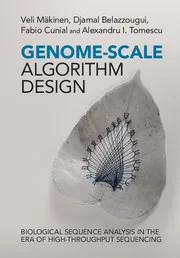
Genome-Scale Algorithm Design: Biological Sequence Analysis in the Era of High-Throughput Sequencing
Veli Mäkinen et al.
English
Beginner
Algorithms
4.5 / 5
0 reviews
2015
Published
413
pages
671
views
High-throughput sequencing has revolutionised the field of biological sequence analysis. Its application has enabled researchers to address important biological questions, often for the first time. This book provides an integrated presentation of the fundamental algorithms and da
Before you read
What will you get from this book?
High-throughput sequencing has revolutionised the field of biological sequence analysis. Its application has enabled researchers to address important biological questions, often for the first time. This book provides an integrated presentation of the fundamental algorithms and data structures that power modern sequence analysis workflows. The topics covered range from the foundations of biological sequence analysis (alignments and hidden Markov models), to classical index structures (k-mer indexes, suffix arrays and suffix trees), Burrows–Wheeler indexes, graph algorithms and a number of advanced omics applications. The chapters feature numerous examples, algorithm visualisations, exercises and problems, each chosen to reflect the steps of large-scale sequencing projects, including read alignment, variant calling, haplotyping, fragment assembly, alignment-free genome comparison, transcript prediction and analysis of metagenomic samples. Each biological problem is accompanied by precise formulations, providing graduate students and researchers in bioinformatics and computer science with a powerful toolkit for the emerging applications of high-throughput sequencing.
Provides an integrated picture of the fundamental algorithms and data structures that power modern sequence analysis, covering a range of topics including foundations, classical index structures and Burrows–Wheeler indexes
Chapters feature numerous examples, algorithm visualisations, problems and end-of-chapter exercises, providing students with a powerful toolkit for the emerging applications of high-throughput sequencing
Presents only the minimum data structures necessary so that students are not burdened with technical results and can also focus on more conceptual algorithm design questions
Ask this book
Your question is answered in the context of this title and author. Each answer uses 2 points.
Sign in to ask the book assistant.
Reader reviews
0 reviews, 4.5 average out of 5
No reviews yet
If you have read this book, help the next reader with your experience.
Write a review
Sign in to publish a review.
Reader questions and answers
Ask a focused question and learn from the community.
Sign in to ask or answer a question.
No questions yet
Be the first to ask a clear, useful question.
What to read next
Related references that continue this learning path.