

The Law of Corporate Finance: General Principles and EU Law: Volume II: Contracts in General
Petri Mäntysaari (auth.)
2010
View book
Book guide and evaluation
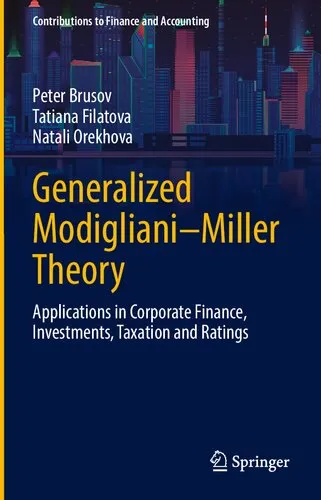
Peter Brusov,Tatiana Filatova,Natali Orekhova
0 reviews
Published
pages
views
Introduction to Generalized Modigliani–Miller Theory: Applications in Corporate Finance, Investments, Taxation and Ratings Welcome to an exploration of the pivotal book 'Generalized Modigliani–Miller Theory: Applications in Corporate Finance, Investments, Taxation
Before you read
Welcome to an exploration of the pivotal book 'Generalized Modigliani–Miller Theory: Applications in Corporate Finance, Investments, Taxation and Ratings', a cornerstone in contemporary financial literature. This book serves as an advanced guide through the complexities of financial structuring, highlighting a nuanced understanding of financial theories that significantly contribute to corporate finance, investment strategies, taxation mechanisms, and credit ratings.
The 'Generalized Modigliani–Miller Theory' extends upon the foundational principles set forth by Franco Modigliani and Merton Miller, whose original theory postulates that, in an ideal market, the value of a company is unaffected by its financing methods. This book revisits these assumptions to suit the dynamic financial landscapes of today, underlining how real-world elements like taxes, bankruptcy risks, and agency costs influence corporate capital structures.
Throughout its carefully structured chapters, the book delves into the applicability of the Modigliani-Miller theorem in diversified settings. By examining realistic market conditions, it sheds light on how capital structure theories can optimize corporate financial decisions in nuanced environments. Readers are guided through complex computations, ultimately providing a unified approach to understanding financial leverage, equity cost strategies, and the consequential implications on firm valuation.
"Financial structures are only as strong as the assumptions they are built upon. By reevaluating these assumptions, we enhance not only theoretical models but the practicality of their applications."
As we navigate through complex financial landscapes, the need for a deeper understanding of the interplay between financial theory and market realities becomes imperative. This book bridges the gap, offering a comprehensive analysis that transcends traditional paradigms, effectively equipping financial professionals, academics, and policymakers with critical insights. Its innovative approach not only educates but inspires a reevaluation of the financial strategies that drive today’s global marketplace. By infusing traditional principles with contemporary relevance, it contributes to a more resilient, adaptive framework for financial decision-making.
Your question is answered in the context of this title and author. Each answer uses 2 points.
0 reviews, 4.3 average out of 5
Sign in to publish a review.
Ask a focused question and learn from the community.
Related references that continue this learning path.
Petri Mäntysaari (auth.)

Petri Mäntysaari (auth.)

Petri Mäntysaari (auth.)

David Hillier,Mark Grinblatt,Sheridan Titman