

Book guide and evaluation
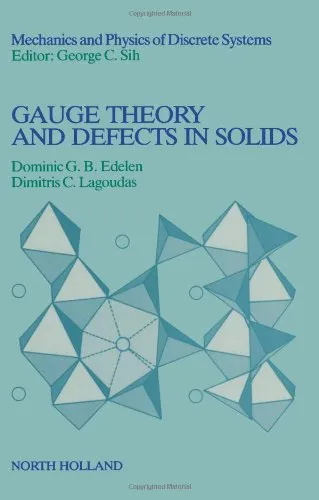
Gauge Theory and Defects in Solids
DOMINIC G.B. EDELENandDIMITRIS C. LAGOUDAS (Eds.)
English
Beginner
Condensed Matter
4.2 / 5
0 reviews
1988
Published
427
pages
360
views
Introduction to "Gauge Theory and Defects in Solids" “Gauge Theory and Defects in Solids” delves deeply into the intersection of theoretical physics and materials science, offering groundbreaking perspectives that unify concepts from gauge theory with the behavior of defects i
Before you read
What will you get from this book?
Introduction to "Gauge Theory and Defects in Solids"
“Gauge Theory and Defects in Solids” delves deeply into the intersection of theoretical physics and materials science, offering groundbreaking perspectives that unify concepts from gauge theory with the behavior of defects in solid-state materials. This book serves as a cornerstone for researchers, theorists, and advanced students who aim to bridge the realms of mathematical physics and applied sciences.
Edited by Dominic G.B. Edelen and Dimitris C. Lagoudas, the book takes readers on an intellectual journey where the complexities of material imperfections, such as dislocations and disclinations, are explored through the lens of modern mathematical frameworks. By drawing connections between abstract gauge theory and real-world challenges in materials engineering, the text not only addresses fundamental questions in the mechanics of solids but also lays pathways for technological advancements across multiple industries. From aerospace applications to microelectronics, the book provides insights into how the understanding of material defects can pave the way for innovative solutions.
Summary of the Book
An intellectual fusion of applied physics and advanced mathematics.
“Gauge Theory and Defects in Solids” opens with a thorough review of the foundational concepts of gauge fields and their historical significance in physics. Readers are introduced to fundamental principles from differential geometry and fiber bundles, which form the backbone of gauge theories. These tools are systematically applied to solid-state mechanics to illustrate the mathematical representation of defects in solids.
The book is structured to build understanding progressively. The initial chapters introduce core concepts, followed by applications that tie these ideas to material defects—such as dislocations, disclinations, and cracks. Later chapters delve into specific case studies, illustrating the profound implications of gauge theory in predicting and analyzing the behavior of materials under various conditions.
What sets this book apart is its interdisciplinary approach. It not only discusses the mechanics of materials but also introduces mathematical methodologies that allow these principles to be extended far beyond traditional applications. As a result, the book provides readers with a toolkit for exploring uncharted territories of material defects, offering both theoretical rigor and practical relevance.
Key Takeaways
- A clear understanding of the principles of gauge theory and its extensions to material science.
- A mathematical framework for modeling defects in solid materials, including differential geometry and fiber bundles.
- Comprehensive knowledge of how dislocations, disclinations, and cracks can be described and analyzed through modern physics tools.
- Interdisciplinary insights into how material imperfections contribute to mechanical and physical behaviors of solids.
- Applicable solutions for real-world challenges in materials engineering, particularly in high-performance sectors like aerospace and nanotechnology.
Famous Quotes from the Book
"Gauge theory provides not only a mathematical framework but also a philosophical lens through which the complexities of material imperfections can be understood."
"The unification of physics and materials science via gauge theory is not merely theoretical curiosity—it is a bridge to technological revolutions."
Why This Book Matters
A cornerstone of modern understanding in material mechanics.
The significance of “Gauge Theory and Defects in Solids” lies in its unparalleled integration of abstract mathematical physics with tangible applications in engineering. It boldly steps into an interdisciplinary space, addressing the deficiencies of traditional theories by providing a robust framework to explore and describe material defects.
By fostering a deeper appreciation for the interplay between geometry and physical phenomena, the book equips the scientific community with tools to innovate. Whether one’s focus is academic exploration or industrial applications, this book offers unique and compelling insights into a field where theoretical and applied sciences converge. For those seeking to be at the forefront of materials science and engineering, this work is an essential resource.
In summary, “Gauge Theory and Defects in Solids” matters because it lays the foundations for a new era in material understanding. Its profound intellectual depth and practical relevance make it an enduring achievement in the field of applied physics and materials science.
Ask this book
Your question is answered in the context of this title and author. Each answer uses 2 points.
Sign in to ask the book assistant.
Reader reviews
0 reviews, 4.2 average out of 5
No reviews yet
If you have read this book, help the next reader with your experience.
Write a review
Sign in to publish a review.
Reader questions and answers
Ask a focused question and learn from the community.
Sign in to ask or answer a question.
No questions yet
Be the first to ask a clear, useful question.
What to read next
Related references that continue this learning path.
Modern Many-Particle Physics: Atomic Gases, Quantum Dots and Quantum Fluids
Enrico Lipparini
2004
View book
Quantum Field Theory : Feynman Path Integrals and Diagrammatic Techniques in Condensed Matter
Fai,Lukong Cornelius
2020
View book

Topological Insulators and Topological Superconductors
B. Andrei Bernevig,Taylor L. Hughes
2013
View book