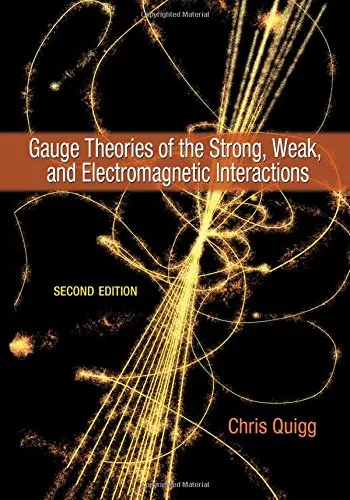
Introduction to "Gauge Theories of the Strong, Weak, and Electromagnetic Interactions: Second Edition"
Written by Chris Quigg, "Gauge Theories of the Strong, Weak, and Electromagnetic Interactions: Second Edition" serves as an insightful guide through the fundamental principles governing particle physics. It is both an authoritative text and a masterful exploration of the theoretical framework that connects the strong, weak, and electromagnetic interactions under the umbrella of gauge theories.
The book transcends traditional pedagogical approaches by effectively bridging foundational concepts and modern advancements in theoretical physics. Designed with advanced students, researchers, and seasoned physicists in mind, this comprehensive volume revisits the Standard Model in light of new discoveries while also elucidating its evolving challenges and limitations. Emphasizing both formalism and physical intuition, the book seamlessly combines mathematical rigor with conceptual clarity, making it an indispensable resource for those seeking to deepen their understanding of gauge theories.
Detailed Summary of the Book
This second edition builds on the success of the first by incorporating recent developments in gauge theories and their applications to the strong, weak, and electromagnetic forces. The text begins by laying a thorough foundation, covering the mathematical essentials of gauge invariance and symmetry principles. The Standard Model is systematically introduced, with an emphasis on its key components: quantum electrodynamics (QED), quantum chromodynamics (QCD), and the electroweak theory.
Subsequent chapters delve deeply into each of the fundamental interactions. Readers are guided through intricate topics such as running coupling constants, spontaneous symmetry breaking, and the renormalization group. A significant portion of the text is dedicated to the Higgs mechanism and its critical role in mass generation, as well as experimental confirmations of the Standard Model, including collider experiments and precision measurements.
The book also explores physics beyond the Standard Model, introducing readers to grand unified theories, supersymmetry, and potential avenues for expanding our understanding of the fundamental forces. Throughout, the author combines a historical perspective with forward-looking insights, offering a balanced view of where theoretical physics stands today and what challenges lie ahead.
Key Takeaways
- A thorough understanding of the mathematical framework underlying gauge theories, including group theory and symmetry principles.
- Comprehensive coverage of the Standard Model, including QED, QCD, and electroweak theory, with detailed explanations of their experimental validations.
- In-depth discussion of important theoretical tools such as spontaneous symmetry breaking, the Higgs mechanism, and renormalization.
- Insights into the current challenges and limitations of the Standard Model, leading readers to explore physics beyond the Standard Model.
- An elegant combination of historical context, theoretical rigor, and practical insight for students and researchers alike.
Famous Quotes from the Book
"Gauge theories are the cornerstone of our understanding of the fundamental forces of nature, unifying the strong, weak, and electromagnetic interactions within a coherent mathematical framework."
"The Standard Model of particle physics represents not only a remarkable triumph of human thought but also a lasting foundation for the pursuit of physics beyond its boundaries."
Why This Book Matters
In the rapidly evolving field of particle physics, staying up-to-date with both foundational knowledge and the latest developments is essential. "Gauge Theories of the Strong, Weak, and Electromagnetic Interactions: Second Edition" is a valuable resource for this purpose, offering readers an unmatched level of insight and clarity. Its combination of theoretical depth, mathematical rigor, and practical examples allows students and researchers to develop a nuanced understanding of gauge theories and their experimental implications.
The book’s emphasis on both pedagogy and vision ensures its relevance for years to come. By seamlessly connecting past triumphs in theoretical physics with current challenges and opportunities, it encourages aspiring scientists to push the boundaries of what we know about the universe. Whether one seeks to master the fundamentals or to contribute to the next breakthroughs in particle physics, Chris Quigg’s exploration of gauge theories provides a solid intellectual foundation and an inspiring roadmap for future discoveries.