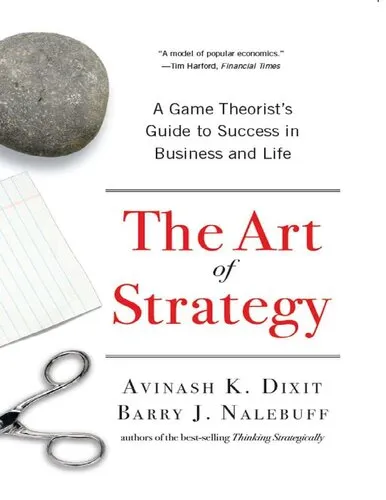
The Art of Strategy: A Game Theorist's Guide to Success in Business and Life
Avinash K. Dixit,Barry J. Nalebuff
2008
View book
Book guide and evaluation
Peter C. Ordeshook
0 reviews
Published
pages
views
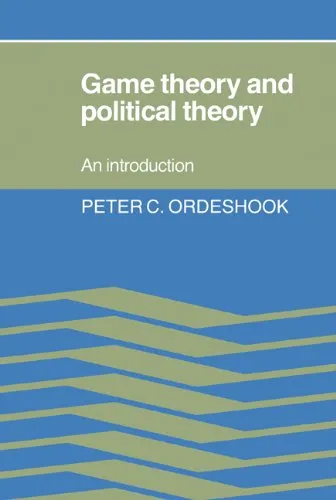
Introduction to Game Theory and Political Theory: An Introduction Written by Peter C. Ordeshook, Game Theory and Political Theory: An Introduction serves as a comprehensive guide for students, researchers, and professionals keen on bridging the gap between political science an
Before you read
Written by Peter C. Ordeshook, Game Theory and Political Theory: An Introduction serves as a comprehensive guide for students, researchers, and professionals keen on bridging the gap between political science and the mathematical foundations of game theory. This seminal work introduces readers to the core principles of game theory and its application to the real-world complexities of political behavior, strategic interaction, and decision-making. By providing a clear exposition of theory backed by practical examples, the book exemplifies how abstract models can be applied to political realities, from voting systems to legislative bargaining.
The book begins with the basics of game theory, offering definitions of essential concepts like utility, preferences, strategies, and equilibrium. Ordeshook carefully constructs the foundation for a scientific understanding of human interaction, emphasizing rational choice theory and strategic behavior. Building on these principles, the text explores the application of game theory to various facets of political science, such as electoral competition, coalition formation, and the interplay between institutions and individual actors.
The book’s modular approach allows readers to gradually move from simple games and scenarios to more complex models that incorporate uncertainty, mixed strategies, and repeated interactions. Topics such as Nash equilibria, backward induction, and subgame perfection are explored in detail, with a focus on ensuring readers grasp both their theoretical significance and practical implications.
Ordeshook also delves into cooperative game theory and its relevance to political coalition-building, providing insights into why certain alliances form and persist while others fail. The concluding chapters discuss broader theoretical debates in political science, addressing the critiques and limitations of applying game theory to human behavior. The author does not merely present game theory as a tool but explores its philosophical and ethical implications, making the book a holistic resource for readers interested in both science and the moral dilemmas of politics.
"Understanding the incentives of individual actors within a system enables us to predict outcomes that, at first glance, may seem chaotic or unpredictable."
"In politics, as in games, the structure of rules defines the strategies, and the strategies define the consequences."
"Game theory is not merely a mathematical abstraction, but a lens through which we can better perceive the strategic nature of human interaction."
Game theory has revolutionized the social sciences, and this book makes it accessible for political scientists and policymakers alike. By distilling complex mathematical concepts into clear explanations and relatable examples, Ordeshook’s work provides invaluable tools for anyone seeking to understand the strategic underpinnings of political and social behavior. The book is especially significant for those studying democracy, international relations, or policy design, as it lays bare the mechanisms that drive decisions in high-stakes environments.
Furthermore, Game Theory and Political Theory: An Introduction serves as a bridge between theory and practice, fostering a deeper appreciation of the strategic challenges faced by political actors. By demonstrating the elegance of game theory while acknowledging its limitations, the book encourages critical thinking and innovation in the study of political systems. Ultimately, this work is not just an introduction to game theory but a call to rigorously apply intellectual tools to better understand and improve the world in which we live.
Your question is answered in the context of this title and author. Each answer uses 2 points.
0 reviews, 4.5 average out of 5
Sign in to publish a review.
Ask a focused question and learn from the community.
Related references that continue this learning path.
Avinash K. Dixit,Barry J. Nalebuff