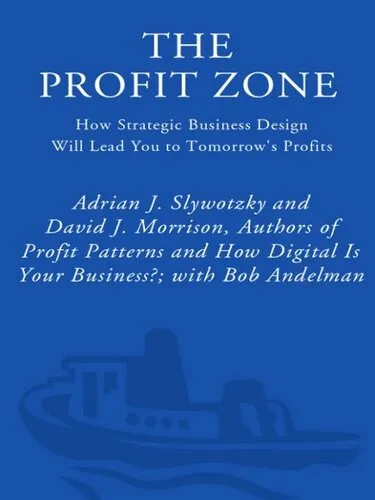
The Profit Zone: How Strategic Business Design Will Lead You to Tomorrow's Profits
Adrian J. Slywotzky;David J. Morrison;Bob Andelman
2007
View book
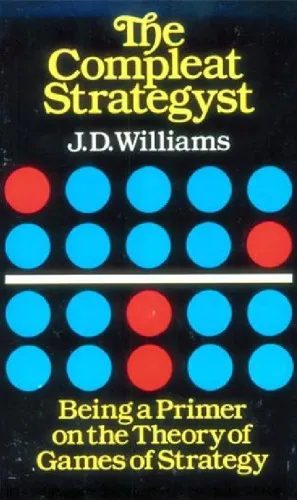
Book guide and evaluation
J. D. Williams
0 reviews
Published
pages
views
Introduction to "The Compleat Strategyst: Being a Primer on the Theory of Games of Strategy" "The Compleat Strategyst," authored by J. D. Williams, stands as one of the most enduring and accessible introductions to the profound field of game theory. Originally aimed to mak
Before you read
"The Compleat Strategyst," authored by J. D. Williams, stands as one of the most enduring and accessible introductions to the profound field of game theory. Originally aimed to make the study of strategic thinking understandable and engaging, this book spans the intersections of mathematics, psychology, and decision-making. The engaging title hints at a rich exploration of strategic behavior, designed for enthusiasts and professionals alike who seek clarity and depth in complex decision-making problems. With its lucid writing and practical exercises, this book balances rigor and simplicity, making it an invaluable resource for anyone interested in the art of strategy.
The volume was initially developed during the early formative years of game theory, inspired by the works of John von Neumann and Oskar Morgenstern. J. D. Williams manages to distill the key principles of this sophisticated mathematical theory into straightforward, digestible concepts accessible even to those with limited mathematical backgrounds. More than just theory, the book integrates real-world applications, puzzles, and examples that challenge the reader's strategic thinking across disciplines.
For students, professionals, and curious readers alike, "The Compleat Strategyst" offers both entertainment and enlightenment. It remains one of the cornerstones of game theory literature and continues to guide systematic decision-making in areas ranging from economics to political science, business, and beyond.
At its core, "The Compleat Strategyst" introduces readers to the fundamentals of game theory — the study of strategic interactions between rational decision-makers. The book begins by outlining the essential concepts of strategy, including zero-sum games, cooperative and non-cooperative strategies, and the nature of decision-making under uncertainty. Williams ensures each concept is presented clearly through thought-provoking examples, starting with basic problems before progressing toward more sophisticated challenges.
As the narrative unfolds, the author delves into key topics such as payoff matrices, minimax solutions, and mixed strategies. The book emphasizes the balance between mathematical formalism and practical relevance, offering readers insights into how theoretical models apply to real-life decision-making. With a strong focus on problem-solving, Williams accompanies each theoretical framework with exercises and scenarios designed to make the learning process engaging.
Midway through the text, the discussion advances to multi-player dynamics and complex games involving strategies that go beyond zero-sum interactions. Williams artfully shows how cooperation, trust, and compromise play critical roles in complex strategic environments, especially when players seek mutual gain. By the end of the book, readers are equipped not only with analytical tools but also with a deeper understanding of how decision-making shapes outcomes across a variety of domains.
"Strategy is not just about optimizing your own results but also about accounting for the moves and motives of those you interact with."
"To win at the game of strategy, one must first learn to think like their adversary."
"The science of strategy is less about complex calculations and more about simplifying complexity."
"The Compleat Strategyst" matters because it brings the intricate world of game theory to a broad audience without compromising on depth or quality. Unlike many highly technical works in the field, Williams crafts a narrative that is equally suited for mathematical novices and experts. This balance has made the book a classic, retaining its relevance decades after its initial publication.
Beyond its academic merits, the book is profoundly practical. From business leaders to policymakers, professionals across industries continue to rely on its teachings to make balanced, informed decisions. By demystifying abstract concepts, it inspires readers to think critically about everyday decisions that involve competition, cooperation, and strategic planning.
Ultimately, the book's enduring value lies in its ability to simplify complex ideas while challenging readers to apply critical thinking. For anyone looking to sharpen their strategic mind and gain a deeper appreciation of how decisions are interconnected, "The Compleat Strategyst" is a must-read.
Your question is answered in the context of this title and author. Each answer uses 2 points.
0 reviews, 4.5 average out of 5
Sign in to publish a review.
Ask a focused question and learn from the community.
Related references that continue this learning path.
Adrian J. Slywotzky;David J. Morrison;Bob Andelman

Adrian J. Slywotzky