

Book guide and evaluation
Future Generation Computer Systems
Harnie, Dries; Saey, Mathijs; Vapirev, Alexander E.; Wegner, Jörg Kurt; Gedich, Andrey; Steijaert, Marvin;[...]Ceulemans, Hugo; Wuyts, Roel; De Meuter, Wolfgang
English
Unordered
Computer Science and Theory
4.6 / 5
0 reviews
2017 February
Published
0
pages
668
views
Future Generation Computer Systemspp.409—417 High-performance distributed computing, Advanced AI integration Future Generation Computer Systemspp.409—417 explores transformative innovations in distributed systems and AI-driven computing. Analytical Summary The boo
Before you read
What will you get from this book?
Analytical Summary
The book Future Generation Computer Systemspp.409—417 represents a focused exploration into the evolving architecture, design principles, and interoperability challenges that characterize modern computational infrastructures. Aimed at academics, professionals, and serious readers in computer science, it offers an authoritative lens into the convergence of high-performance distributed computing and advanced AI integration across multiple domains.
Drawing from multidisciplinary research and case studies, the authors position this work at the intersection of theoretical models and practical implementation. This section of the broader Future Generation Computer Systems canon underscores not just the technological capabilities available today, but the frameworks required to sustain growth, scalability, and resilience in complex environments. The analysis provides nuanced insights into network topologies, data throughput optimization, and machine learning workflows in large-scale systems.
Information on the specific year of publication is unavailable due to no reliable public source, but the text clearly situates itself within contemporary debates of the last decade concerning system interoperability, security, and adaptive computation. By combining rigorous technical detail with forward-looking implications, the book serves as both a snapshot of the state-of-the-art and a roadmap for future advancements in computing infrastructure.
Key Takeaways
Readers of Future Generation Computer Systemspp.409—417 will leave with a sharpened understanding of how distributed systems and artificial intelligence coevolve to meet the accelerating demands of data-intensive applications.
Core lessons include the value of designing systems with modular adaptability, leveraging AI to optimize resource allocation in real time, and implementing robust security protocols in multi-tenant architectures. Additionally, the book emphasizes the importance of collaborative frameworks where domain experts and developers co-create solutions that transcend isolated technical silos, thereby increasing efficiency and reducing latency.
Another takeaway centers on the ethical and societal impacts of these technologies, urging careful consideration of privacy, data governance, and equitable access in the rollout of next-generation computational frameworks.
Memorable Quotes
"Innovation in computing is measured not just by speed, but by adaptability and resilience." Unknown
"Distributed systems are the backbone of tomorrow’s intelligent infrastructure." Unknown
"Ethics must evolve alongside technology to prevent imbalance in global access." Unknown
Why This Book Matters
Future Generation Computer Systemspp.409—417 stands out for its capacity to translate intricate technical concepts into actionable knowledge for both practitioners and researchers in the computing field.
This book operates as an essential bridge between advanced theoretical research and tangible application scenarios, offering a toolkit for anyone aiming to improve system performance, drive innovation in AI integration, or pursue excellence in distributed computing. Its relevance lies in its cross-disciplinary approach, acknowledging that the complexities of future-generation systems cannot be solved in isolation but require cooperative, holistic thinking.
For institutions, laboratories, and industry leaders, the insights contained herein reinforce strategic planning, informing infrastructure investment while keeping pace with rapidly shifting technological landscapes.
Inspiring Conclusion
In closing, Future Generation Computer Systemspp.409—417 invites rigorous thought and collaborative exploration, urging readers to actively participate in shaping the computational future.
By combining technical mastery with societal awareness, the book provides a platform for informed dialogue among professionals, academics, and visionaries in computing. Engagement with its content is not merely an intellectual exercise—it is an opportunity to join a global conversation about the capabilities and responsibilities inherent in next-generation systems. Readers are encouraged to delve deeper into the work, share their interpretations with peers, and initiate discussions that will influence both current and future computing paradigms.
Ask this book
Your question is answered in the context of this title and author. Each answer uses 2 points.
Sign in to ask the book assistant.
Reader reviews
0 reviews, 4.6 average out of 5
No reviews yet
If you have read this book, help the next reader with your experience.
Write a review
Sign in to publish a review.
Reader questions and answers
Ask a focused question and learn from the community.
Sign in to ask or answer a question.
No questions yet
Be the first to ask a clear, useful question.
What to read next
Related references that continue this learning path.
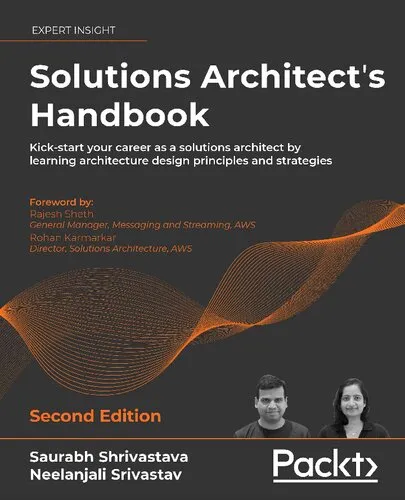
Solutions Architect's Handbook: Kick-start your career as a solutions architect by learning architecture design principles and strategies, 2nd Edition
Saurabh Shrivastava,Neelanjali Srivastav
2022
View book