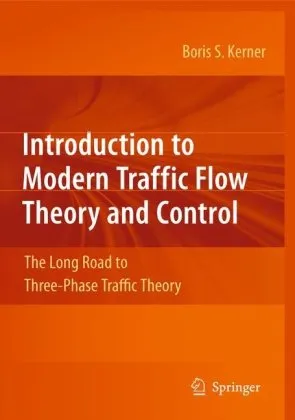
Introduction to Modern Traffic Flow Theory and Control: The Long Road to Three-Phase Traffic Theory
Boris S. Kerner (auth.)
2009
View book
Book guide and evaluation
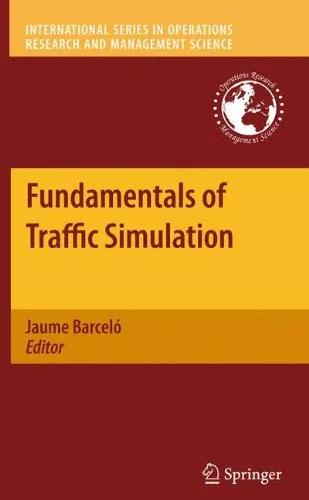
Jaume Barceló (auth.),Jaume Barceló (eds.)
0 reviews
Published
pages
views
Introduction to Fundamentals of Traffic Simulation The complex and interdisciplinary field of traffic simulation is a cornerstone of modern transportation research and engineering. "Fundamentals of Traffic Simulation," edited by Jaume Barceló, presents a comprehensive guide to
Before you read
The complex and interdisciplinary field of traffic simulation is a cornerstone of modern transportation research and engineering. "Fundamentals of Traffic Simulation," edited by Jaume Barceló, presents a comprehensive guide to the theories, methodologies, and applications that define this dynamic area. This book is designed for both students and professionals seeking a deeper understanding of traffic flow dynamics and their simulation through advanced computational models.
The book "Fundamentals of Traffic Simulation" encapsulates a thorough examination of the principles and techniques pivotal for simulating traffic systems accurately. It addresses the foundations of traffic simulation by discussing key concepts like flow theory, model calibration, and performance assessment. Each chapter is meticulously crafted to present theoretical contents, practical applications, and quantitative analysis of traffic models, making it an essential resource for traffic engineers and researchers.
The book is divided into sections that build up from basic principles to complex simulation frameworks. Initial chapters introduce fundamental concepts of traffic flow theories, which lay the groundwork for understanding subsequent simulation models. Midway through the text, the focus transitions to the design and implementation of microscopic and macroscopic simulation models, emphasizing calibration and validation processes that ensure the models' accuracy. The latter sections delve into specific applications of traffic simulation, such as intelligent transportation systems (ITS), providing insights into how these simulations can solve real-world problems.
"Traffic simulation is not just a tool; it's a methodology that represents the dynamic reality of vehicular movements and human interactions."
"Through detailed modeling and simulation, we uncover patterns that lead to more efficient, safe, and sustainable transportation networks."
The importance of "Fundamentals of Traffic Simulation" in its field cannot be overstated. As urban areas expand and population densities increase, efficient traffic management becomes crucial for sustaining mobility and reducing environmental impact. This book equips practitioners and scholars with the knowledge needed to design advanced simulation models that accurately reflect real-world scenarios, thereby enabling informed decision-making in traffic planning and management.
Furthermore, the book stands out due to its interdisciplinary approach. It integrates concepts from computer science, engineering, and sociology to provide a holistic view of traffic systems. This integrative perspective is vital for developing simulations that are not only technically sound but also considerate of human factors, such as driver behavior and pedestrian dynamics.
"Fundamentals of Traffic Simulation" is more than just an academic textbook; it’s a pivotal resource that provides the intellectual tools necessary to tackle contemporary transportation challenges. Whether you are involved in urban planning, policy-making, or engineering projects, the insights gained from this book will enhance your ability to contribute to more efficient and livable cities.
Your question is answered in the context of this title and author. Each answer uses 2 points.
0 reviews, 4.5 average out of 5
Sign in to publish a review.
Ask a focused question and learn from the community.
Related references that continue this learning path.
Boris S. Kerner (auth.)