

Book guide and evaluation
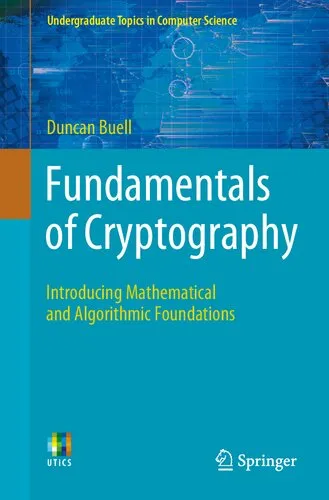
Fundamentals of Cryptography: Introducing Mathematical and Algorithmic Foundations (Undergraduate Topics in Computer Science)
Duncan Buell
English
Beginner
Software Engineering
4.3 / 5
0 reviews
2021
Published
283
pages
170
views
Introduction to "Fundamentals of Cryptography: Introducing Mathematical and Algorithmic Foundations" Cryptography, at its heart, is the art and science of ensuring secure communication. As digital systems grow and technology pervades every aspect of our lives, the demand f
Before you read
What will you get from this book?
Introduction to "Fundamentals of Cryptography: Introducing Mathematical and Algorithmic Foundations"
Cryptography, at its heart, is the art and science of ensuring secure communication. As digital systems grow and technology pervades every aspect of our lives, the demand for secure, encrypted exchanges of information has become critical. My book, "Fundamentals of Cryptography: Introducing Mathematical and Algorithmic Foundations", is designed to introduce readers to the essential elements of modern cryptography and its rigorous mathematical underpinnings. It aims to bridge the gap between complex theoretical concepts and practical applications, catering to undergraduate students, novice learners, and even curious tech enthusiasts who are keen to explore the algorithms powering global encryption standards.
Written as part of the widely-acclaimed Undergraduate Topics in Computer Science series, this book offers a comprehensive yet accessible journey through key topics in classical and modern cryptography. Whether you are preparing for a career in cybersecurity, software development, or data science, understanding the principles of encrypted communication is crucial in today’s data-driven world. In this introduction, I aim to highlight the book's central themes, learning objectives, and why it is an invaluable resource for understanding the rapidly evolving field of cryptography.
Detailed Summary of the Book
The book is systematically structured to serve both as a learning resource and a conceptual guide. It begins with a historical overview of cryptography, tracing its roots from Caesar ciphers to Enigma machines—a fascinating glimpse into how encrypted communication evolved over millennia. From there, the narrative transitions to the mathematics underlying modern cryptographic systems. Foundational concepts such as modular arithmetic, prime numbers, and discrete logarithms are introduced in an approachable manner, laying the groundwork for understanding complex algorithms.
Core chapters delve deeper into modern topics like symmetric-key encryption (e.g., AES), public-key cryptography (e.g., RSA and ECC), cryptographic hash functions, and digital signatures. Each concept is explained through practical examples, step-by-step algorithmic breakdowns, and real-world applications. One of the unique features of this book is its focus on algorithmic thinking—equipping readers with the skills to both implement and analyze cryptographic protocols.
In later portions, more advanced topics like zero-knowledge proofs, elliptic curves, and quantum-safe cryptography are explored to prepare the reader for the next wave of cryptographic innovation. The book also touches upon ethical usage, cryptographic flaws, and the consequences of weak encryption, thus emphasizing the broader societal impact of cryptography.
Key Takeaways
- Gain a profound understanding of the mathematical foundations of cryptographic systems.
- Learn to implement and analyze widely-used encryption algorithms and protocols.
- Develop insights into cryptographic attacks, vulnerabilities, and ways to safeguard against them.
- Understand emerging areas like post-quantum cryptography and their significance for the future.
- Comprehend the ethical and societal implications of cryptography in technology-driven environments.
Famous Quotes from the Book
"Cryptography is not the mere act of encrypting messages; it is the art of building trust in a fundamentally untrusted world."
"When the mathematics is sound and the implementation is flawless, cryptography becomes the most powerful tool against cyber threats. But one weak link in the chain, and the entire system collapses."
"The genius of modern cryptography lies in its adaptability. With every novel challenge, it evolves to meet the demands of a world more interconnected than ever before."
Why This Book Matters
In an era where digital systems govern everything from financial transactions to personal conversations, cryptography has emerged as a cornerstone of data security. Yet, for many, its principles remain shrouded in complexity. This book demystifies the field by presenting its theoretical and algorithmic foundations in a manner accessible to undergraduate students and aspirants from non-mathematical backgrounds. Its relevance extends beyond academia—security professionals, software developers, and even policymakers will find it to be a crucial resource in understanding the fundamentals of encryption.
Unlike other texts, which may focus solely on theory or implementation, "Fundamentals of Cryptography" balances both its scientific rigor and practical utility. The book emphasizes that cryptography is not merely a technical domain but an essential component of modern society. By reading this text, you will emerge equipped with the knowledge and skills to contribute effectively to secure system design, cryptographic research, or the ever-growing landscape of cybersecurity professions.
We live in challenging times, with data breaches, cyberattacks, and ever-present privacy concerns. By understanding the core ideas behind encryption, readers can not only comprehend but also contribute to mitigating these challenges. Therefore, this book matters because it empowers the next generation of thinkers and innovators to build a safer, more secure digital future.
Ask this book
Your question is answered in the context of this title and author. Each answer uses 2 points.
Sign in to ask the book assistant.
Reader reviews
0 reviews, 4.3 average out of 5
No reviews yet
If you have read this book, help the next reader with your experience.
Write a review
Sign in to publish a review.
Reader questions and answers
Ask a focused question and learn from the community.
Sign in to ask or answer a question.
No questions yet
Be the first to ask a clear, useful question.
What to read next
Related references that continue this learning path.



Modern Computer Vision with PyTorch: A Practical Roadmap From Deep Learning Fundamentals to Advanced Applications and Generative AI, 2nd Edition
V Kishore Ayyadevara,Yeshwanth Reddy
2023
View book